23.8 Nuisance parameters and why adjustment is required
The candidate coefficient is not the only direction in which the likelihood can improve. THETA, OMEGA, SIGMA, and already active covariate coefficients are nuisance parameters for the candidate test. If a candidate direction resembles a nuisance direction, raw candidate information overstates how much unique evidence belongs to the candidate.
Efficient-score theory removes the component predictable from nuisance directions. The adjustment uses candidate–nuisance cross-information and the nuisance-information inverse. This is analogous to testing a predictor after accounting for other regressors, although the nonlinear mixed-effects likelihood and conditional modes make the computation more involved.
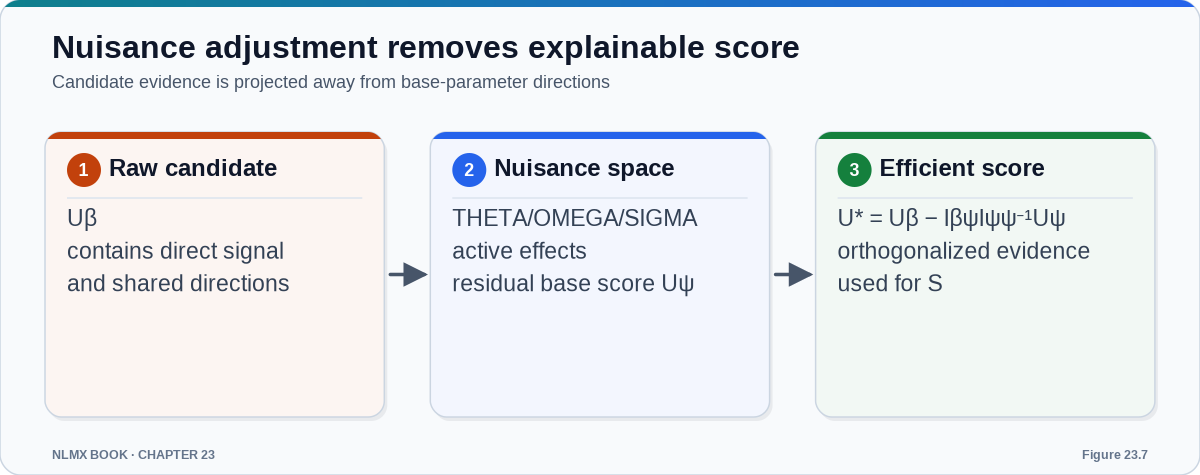
Nuisance adjustment matters particularly when a covariate explains a large portion of an ETA distribution, when fixed and random effects are correlated, when several candidates compete for the same signal, or when the external base estimates are not a perfect stationary point under nlmx's likelihood.
--information candidate-only omits the nuisance projection. It is a valuable diagnostic comparator and can reveal how much adjustment changes a result, but it answers a weaker question. In the worked example, candidate-only information retained all three true continuous effects while the efficient default classified two as uncertain. That difference is not permission to select the preferred answer; it is evidence that nuisance adjustment materially affects the path and targeted refits are needed.
Common mistakes
- Calling candidate-only and efficient tests interchangeable.
- Assuming nuisance adjustment always makes a statistic smaller.
- Ignoring active covariate coefficients as nuisance directions.
- Selecting the information setting after viewing classifications.
- Treating disagreement as a software error without examining the model.
Checklist
- Use efficient information as the primary default.
- Quantify the adjustment fraction and diagnostics.
- Compare candidate-only only as a labeled sensitivity analysis.
- Investigate large changes and collinear directions.
- Use refit evidence to adjudicate material disagreements.
Further reading
Proceed to efficient score, Schur complement, and candidate-only sensitivity.