19.18 Accumulation and Monte Carlo stability
After burn-in, SAEM runs NITER accumulation iterations, default 300. Gamma restarts at one and then follows (1/k'). Parameter/statistic changes shrink as more stochastic batches are averaged.
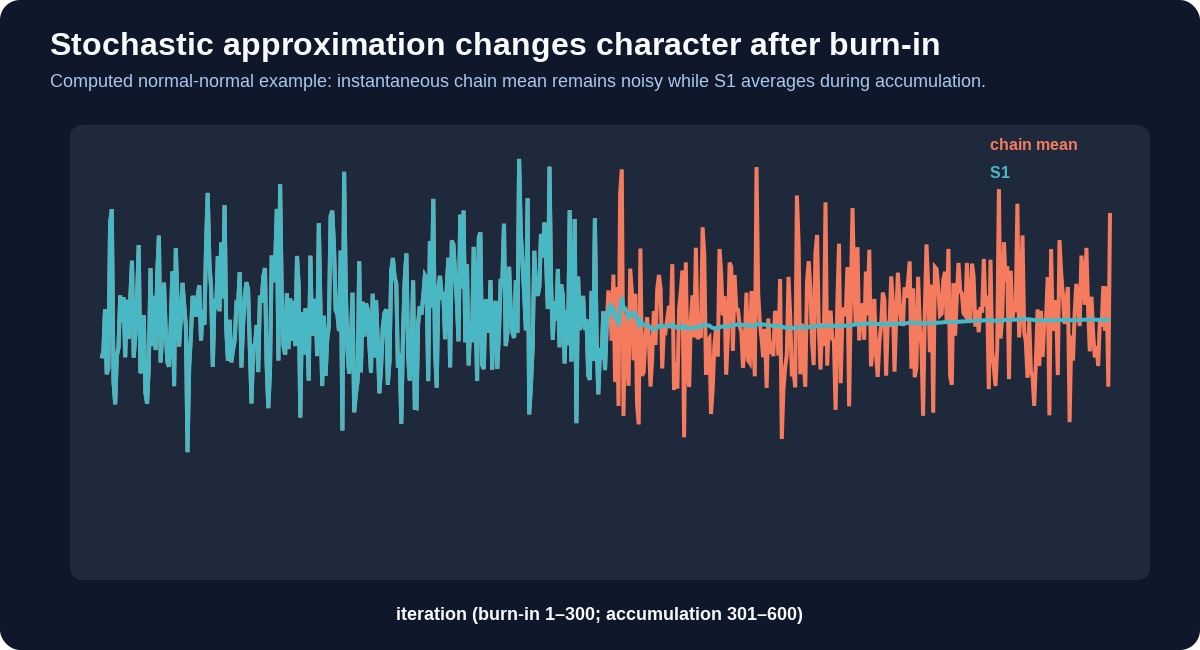
The final estimate should be stable across the late trace, modestly longer accumulation and independent seeds within an analysis-specific tolerance. One noisy path cannot quantify Monte Carlo error reliably. Compare multiple runs or segmented late averages.
More accumulation improves averaging only when chains sample the correct conditional target. Poor mixing creates biased stable-looking estimates. More chains and iterations trade computation for conditional information differently; evaluate both.
Practical interpretation
Split late accumulation into consecutive blocks and calculate means/SDs of each parameter. Differences among blocks approximate remaining Monte Carlo instability but are correlated; independent seeds provide stronger evidence. Report a stochastic precision band or supported digits rather than presenting every stored decimal.
When extending accumulation, preserve the original run and verify the extension uses the same model, seed stream state and burn-in solution. Restarting from scratch with a longer NITER is a different random realization, useful for sensitivity but not a literal continuation.
Archive both parameter statistics and importance-sampling diagnostics, because stable SAEM estimates do not guarantee a precise final marginal likelihood.
Define acceptable between-seed variation for each parameter before final runs. Use absolute criteria near zero and relative criteria elsewhere, just as in cross-software validation.
Common mistakes
Do not average burn-in into final estimates, stop because the last two points are close, or report excessive digits from a stochastic run.
Checklist
- Run the planned NITER fully.
- Inspect late trace and averages.
- Compare seeds and extended accumulation.
- Quantify Monte Carlo variability.
- Report only supported precision.
Further reading
Next distinguish the SAEM objective from the importance-sampling OFV.