23.13 Base-solution stationarity
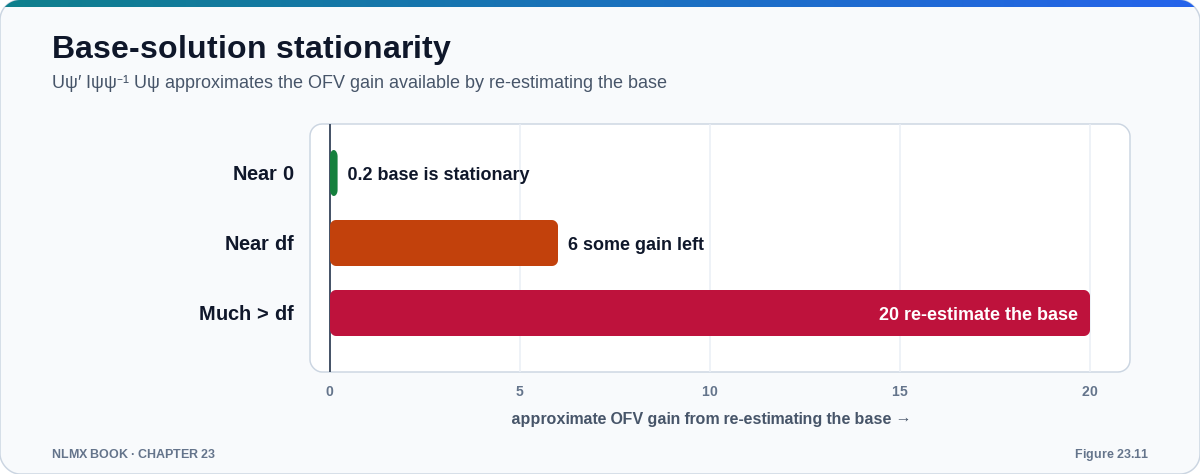
nlmx reports Uψ′ Iψψ⁻¹ Uψ, interpreted as an approximate OFV gain available by re-estimating the frozen nuisance parameters within nlmx's likelihood. At an exact stationary point it is zero. Values near the nuisance degrees of freedom can occur through sampling and approximation, while values much larger than the degrees of freedom signal a substantial mismatch that deserves investigation.
Potential causes include an estimation approximation different from the one requested for screening, rounded EXT estimates, inconsistent control stream/data/artifacts, wrong parameter labels, unsupported code behavior, a covariance/information mismatch, or incomplete convergence of the reference fit. Review the largest standardized nuisance components because they identify which direction is driving the statistic.
The efficient score corrects for nonzero Uψ; this improves the local test but does not certify the base model. A large stationarity statistic means the local expansion is centered at a point from which the base likelihood itself wants to move. In that situation, refit the base under the intended nlmx likelihood or resolve the mapping before interpreting covariate evidence.
The worked Chapter 23 base has stationarity approximately zero on six nuisance degrees of freedom, providing a clean teaching case.
A practical action scale
Use stationarity as a triage diagnostic rather than a pass/fail p-value. A value effectively zero supports immediate continuation. A modest value should trigger comparison of EXT precision, approximation, and the largest standardized components, followed by a documented decision. A value much larger than the nuisance dimension should stop interpretation until the base is reevaluated. The exact boundary must be qualified for the model class; it is not built into the statistic as a universal cutoff. Also compare repeated runs: a sudden stationarity increase after a software or control-stream change is a valuable regression signal even when the candidate classifications happen to remain unchanged.
Common mistakes
- Treating stationarity as a conventional model-fit p-value.
- Comparing the raw statistic without its nuisance degrees of freedom.
- Ignoring the largest component labels.
- Assuming score correction makes a nonstationary base acceptable.
- Proceeding after input artifacts from different runs are mixed.
Checklist
- Record the statistic, degrees of freedom, and components.
- Compare EXT and reconstructed objectives.
- Verify approximation, inputs, and parameter map.
- Refit or repair a materially nonstationary base.
- Re-run all candidates after the base changes.
Further reading
See residual-score correction, base readiness, and troubleshooting.