24.23 Weighted GLS and posterior-variance weights
Weighted GLS fits ETA responses with weights derived from posterior precision. Rich subjects contribute more than weak subjects. Forward selection uses BIC by default, with AIC available, a maximum active set of 25, and a small ridge for numerical stability.
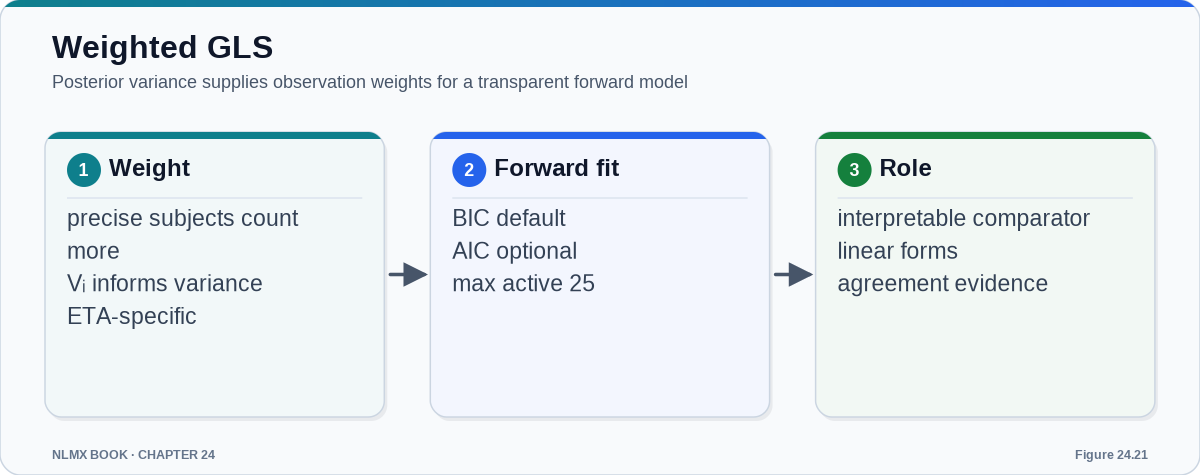
This learner is transparent and provides an interpretable linear comparator to penalized regression. Its assumptions remain linear on the feature/ETA scale, and weights depend on posterior covariance quality. Extremely precise or repaired subjects can dominate; inspect weight distributions.
BIC usually selects smaller models than AIC. Changing criterion changes learner agreement and therefore classification even when the primary learner is unchanged.
Common mistakes
- Treating posterior weights as known sampling variances.
- Ignoring extreme weights.
- Calling forward GLS a population likelihood SCM.
- Changing BIC to AIC after seeing agreement.
- Reporting two-stage GLS coefficients as final effects.
Checklist
- Verify posterior variance and weight range.
- Record criterion, ridge, and active-set cap.
- Review linearity and influential subjects.
- Interpret as an alternative learner.
- Confirm effects with joint model refit.