21.28 Common misspecification patterns and what to test next
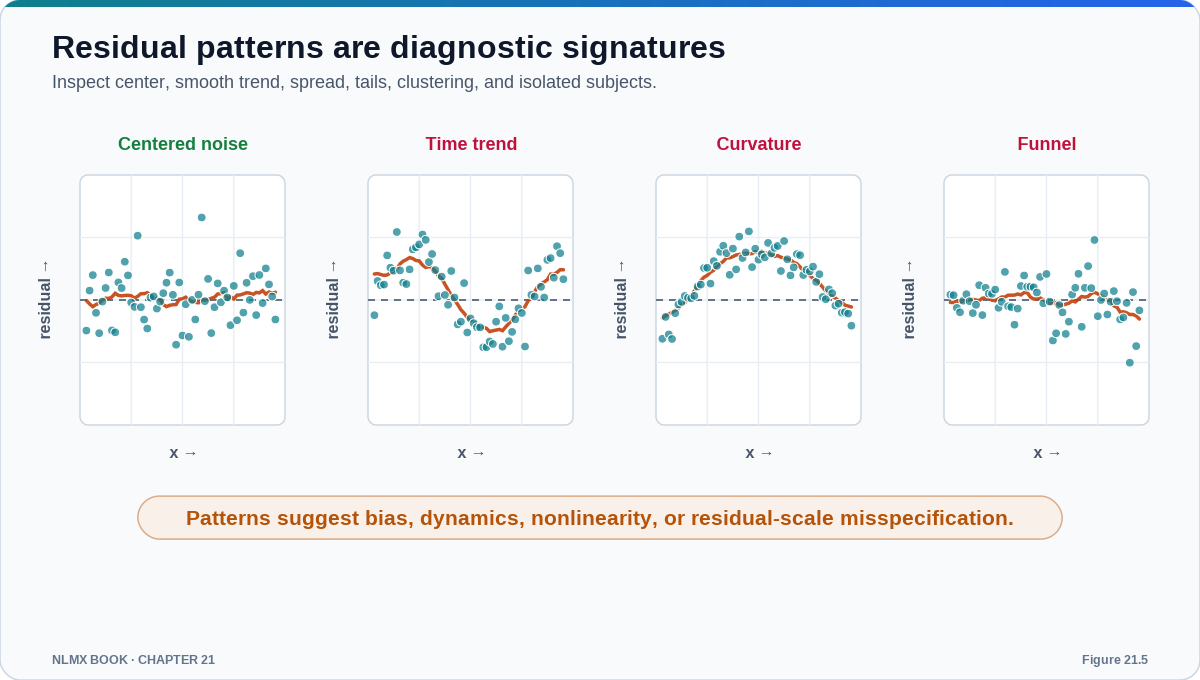
Diagnostic patterns suggest classes of mechanisms; they rarely identify a unique fix. Translate each pattern into competing hypotheses and controlled tests.
| Pattern | Possible explanations | Controlled next checks |
|---|---|---|
| DV–PRED curvature | wrong structure, transformation, missing covariate | fixed-vector prediction check; alternate structure; planned strata |
| early/late residual trend | absorption/distribution/elimination mismatch, timing error | event audit; time-after-dose panels; alternative dynamic model |
| residual funnel | residual-error form, mixed endpoints, dose/time confounding | DVID/strata; compare additive/proportional/combined models |
| subgroup bands | missing categorical effect, study/lab difference | data QC; stratum plots; population covariate test |
| ETA skew/multimodality | transformation, mixture, missing group, shrinkage | sampling review; group labels; alternate parameterization |
| extreme ETA correlation | weak identification, structural compensation, omitted covariance | sensitivity; block OMEGA; reparameterization; design assessment |
| many blank residuals | FFLAG, EXCL, MDV, routing error | record accounting; likelihood-specific diagnostics |
Change one justified feature at a time and preserve row policy, estimation method, and comparison basis. A lower OFV does not automatically validate the proposed mechanism. Review uncertainty, conditioning, parameter plausibility, and predictive consequences.
Some patterns originate in data rather than model equations: wrong units, dose times, infusion duration, CMT, duplicated samples, assay batches, or missing covariate updates. Audit chronology before expanding the model.
Do not pursue cosmetic perfection. Small random deviations are expected, and adding parameters to flatten every smoother can overfit. Prioritize patterns that are reproducible across views, subjects, strata, or validation datasets and that matter for the intended decision.
Common mistakes
- Assuming one visual pattern has one cause.
- Changing structure, error, and covariates simultaneously.
- Choosing a fix solely from OFV improvement.
- Expanding the model before auditing data/events.
- Overfitting minor LOESS deviations.
Checklist
- Describe the pattern, range, strata, and affected subjects.
- List model and data hypotheses.
- Test one mechanism per controlled run.
- Compare diagnostics, likelihood, uncertainty, and plausibility.
- Stop when additional complexity is unsupported or immaterial.
Further reading
Use the decision framework, Chapter 20’s rescue sequence, and Chapter 22 covariate concepts.