42.16 Running the package: records, deviations and the summary report
What you will learn
- Run a complete validation, or a part of one, with the runner and read its output.
- Interpret pass, fail, pending and deviation correctly.
- Handle a failure: record, classify, assess, decide, close.
- Assemble the records an inspector will ask for, and verify them.
Prerequisites: 42.2 The lifecycle, 42.8 IQ and 42.13 Data integrity.
This page is the tester's guide. It assumes the plan is approved and the package is sealed.
A complete run, step by step
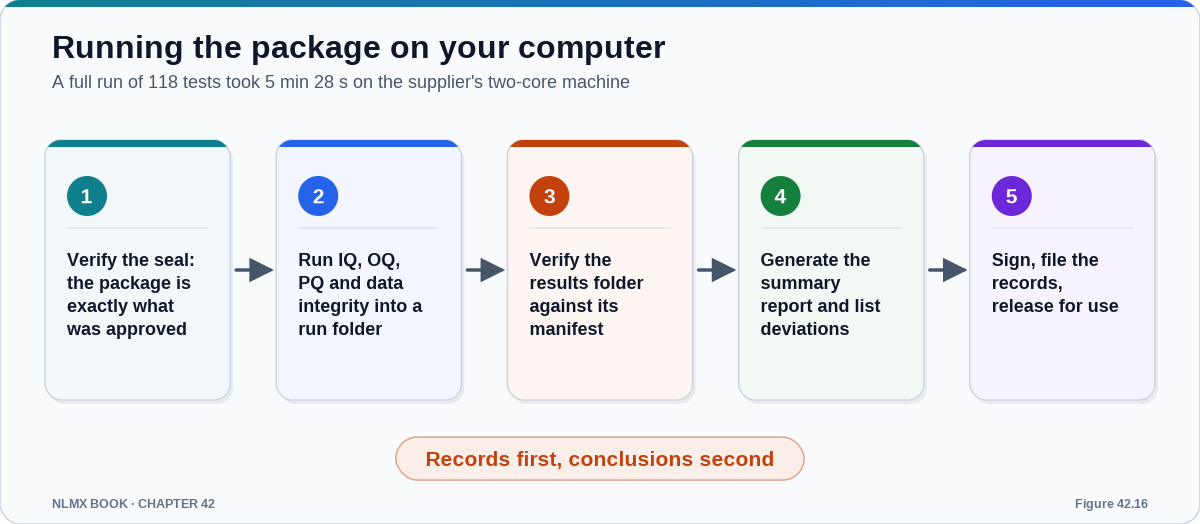
Open a terminal in the folder that contains CFR_VALIDATION. On Windows this is PowerShell or cmd; the scripts are the same on Linux and macOS and use only the Python standard library.
cd CFR_VALIDATION

# 0. is the package intact and sealed?
python tools/seal_package.py --verify

# 1. list the tests
python tools/nlmx_validate.py list

# 2. run everything: IQ, OQ, PQ and data integrity
python tools/nlmx_validate.py run --nlmx C:\path\to\nlmx.exe --tester "Your Name" --label full

# 3. verify the results folder, then write the report
python tools/verify_results.py 10_results/RUN_<date>_<time>_full
python tools/make_summary_report.py 10_results/RUN_<date>_<time>_full -o 10_results/validation_summary_report.md
Step 0 is the gate from the lifecycle: the runner refuses a package that differs from its seal. Step 2 writes a run folder named after the date, time and your label. Step 3 first proves the folder is exactly as it was when the run finished, then writes the report.
To run only part of the package, add one of:
| Option | Runs |
|---|---|
--section 04_IQ |
installation qualification |
--section 05_OQ/fit |
one OQ area |
--section 06_PQ |
performance qualification |
--section 07_data_integrity |
the eleven integrity tests |
--id OQ-FIT-001,OQ-FIT-002 |
single tests |
Other options: --timeout, --results, --interactive (to perform manual tests at the prompt), --no-keep-work (do not keep the per-test work folders; not advised for a validation run, because the work folder is the evidence), and --allow-modified (run a package that differs from its seal; recorded as a deviation).
What a run folder contains
10_results/RUN_<date>_<time>_<label>/
    execution record      who, when, which executable and its SHA-256, which package manifest
    logs/                 every step's console output
    work/                 every output file of every test
    RESULTS_MANIFEST.sha256   the SHA-256 of all of the above
10_results/run_register.csv   one line per run, kept across runs
work/ is the heart of the evidence: it holds the actual outputs the checks examined, so an inspector can re-run a check by hand. verify_results.py proves nothing in the folder changed since the run finished, by recomputing RESULTS_MANIFEST.sha256 and comparing with the register.
Pass, fail, pending, deviation
| Outcome | Meaning | What you do |
|---|---|---|
| Pass | every check of the test held | nothing; it is in the record |
| Fail | at least one check did not hold | stop, record, classify—never "re-run silently" |
| Pending | a manual test not yet performed | perform it per the protocol and sign the execution record |
| Deviation | any departure from the plan or protocol, any failed check, any unexpected behaviour | the deviation procedure below |
Pending is neither a pass nor a failure. The supplier's reference run (page 42.2) had 112 automatic passes and 6 pending: the origin of the executable (IQ-003, IQ-008) and four reviews that need human eyes or a real language model (OQ-ASK-004, OQ-CUS-003, OQ-EDA-003, OQ-REP-003). The acceptance criterion of the plan requires every manual check to be performed and signed, so a summary report with pending tests is incomplete.
The manual tests
| Test | What the human does |
|---|---|
| IQ-003 | compare the executable's SHA-256 with the supplier's release evidence |
| IQ-008 | confirm the supplier documentation is on file |
| OQ-ASK-004 | with a real language model, make a plain-language request and judge the proposed command and its result |
| OQ-CUS-003 | look at the box, histogram and scatter plots in PNG and SVG |
| OQ-EDA-003 | look at the exploratory plots |
| OQ-REP-003 | open the Word and PDF documents and judge layout |
Visual review is manual because layout is a judgement, not a number. It is still evidence: record the file names reviewed, who reviewed them, the date, and the judgement.
When a test fails
The deviation procedure is deliberately procedural so that nothing is hidden or fixed in the moment.
- Stop and record on the deviation report: test id, step, expected and observed result, date and time, person, what was done. Keep the evidence (the runner keeps every step's output). Do not delete or edit the failing record. Do not re-run silently.
- Classify the cause with the validation lead: (a) program defect; (b) test or reference-data defect; (c) environment problem (disk full, clock, antivirus, missing font); (d) tester error; (e) documented limitation (the requirement or the documentation is wrong).
- Assess the risk to the intended use and to earlier results: which analyses could be affected? For High-criticality requirements, escalate to quality assurance the same day.
- Decide the disposition: fix (supplier correction → new version → change control → repeat the affected tests and all tests of the same area); correct the test (change control, re-seal, repeat); repeat after correcting the environment; or accept as a limitation with a written restriction of use and user notification.
- Close with a QA signature after the repeat tests pass or the limitation is documented. The summary report lists every deviation and its closure.
- Log anomalies that are not failures (a slow run, a cosmetic issue, an unclear message) in the anomaly log; QA reviews them at the periodic review.
A failed test is never a reason to loosen a tolerance. A tolerance may be changed only through change control, with a scientific justification (for example a documented difference between CPU architectures), never to make a result pass.
A worked example of classification
You run OQ-FIT-001 on a new server and it fails: THETA2 (typical volume) is 36.4 L against the true 40 L, and the band is ±10 % = [36, 44]. 36.4 is inside the band, so that is not the failing check. Suppose instead the failing check is MINIMIZATION SUCCESSFUL absent from fit_summary.txt, with the final OFV −3017.9 against the baseline −3017.9987 ± 0.05.
- Program defect? The estimates and OFV are within tolerance; the optimiser's convergence flag differs. Look at the transcript: a message about the maximum number of iterations is a hint.
- Environment? The server limits the worker threads to one; IQ-007 would have shown whether threads work. Compare with a run on the validated computer.
- Test defect? The test pins a convergence phrase that may legitimately change with wording. If so, the fix is a test correction under change control, with the justification written.
The classification determines the owner, the next action and the report. Without it, "failed, re-ran, passed" hides a real convergence difference on one machine.
The summary report
make_summary_report.py writes seven sections: outcome; test results; failed tests and deviations; manual checks; requirement status; conclusion; approval. The validation lead adds the things only a human can state:
- the scope and intended use, copied from the plan;
- the identification of the system: version, executable SHA-256, computer and operating system, date, package manifest hash;
- every deviation with its disposition;
- the restrictions of use that follow from deviations or from the Part 11 assessment, including the procedural controls the organisation applies;
- the conclusion, in the form: the program (version, SHA-256) is [fit / fit with the restrictions listed] for the intended use stated in the plan.
Only quality assurance's signature releases the system for use.
What to keep
Under document control, for the retention period of your quality system:
- the approved validation plan and the sealed package (
PACKAGE_MANIFEST.sha256); - every
10_results/RUN_*folder in full, includingwork/andRESULTS_MANIFEST.sha256, plusrun_register.csvand the signed execution records; - deviation reports and their closure;
- the signed summary report;
- the executable's SHA-256 and where it came from.
Store the files on controlled storage, not on a personal laptop; test restores; and after a restore, verify_results.py shows that the files are unchanged.
An inspector's recipe
An inspector who receives your stored analysis and validation can check it independently, with no access to the program:
python CFR_VALIDATION/tools/verify_checksums.py <analysis folder>        # "0 problem(s)" = unchanged
python CFR_VALIDATION/tools/check_input_manifest.py <folder>/input_manifest.json
python CFR_VALIDATION/tools/verify_results.py <validation run folder>
Each command recomputes SHA-256 digests and compares them with a recorded list. Because the digests do not depend on the program, the checks are independent of it—which is the whole point.
Review checklist
- Was
--verifyrun before execution, and does the plan record the manifest hash? - Is every pending manual test performed, signed and dated?
- Is every deviation classified, risk-assessed, dispositioned and closed?
- Was any tolerance touched? If so, is there a change-control number?
- Does the summary report name the executable by SHA-256?
Navigation
See the previous page, the next page and the complete validation reference.