37.11 Custom plot-and-table settings: purpose, structure, and workflow
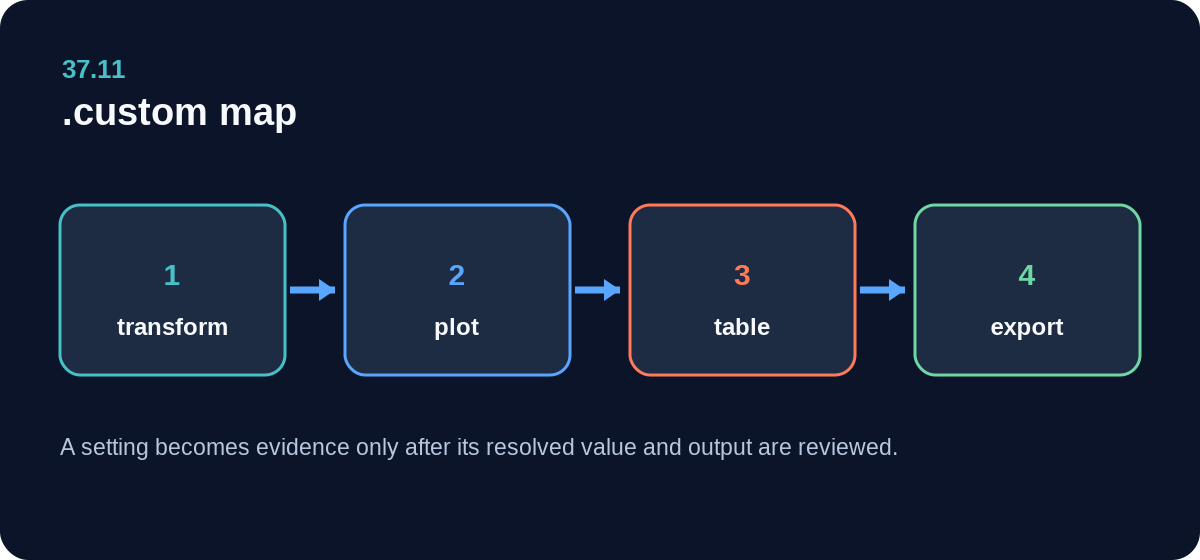
.custom is the settings format for custom. It defines reusable transformations, plot specifications, table specifications, styling and exports for arbitrary tabular data. The template snapshot used here was generated by nlmx 4.16.2; its SHA-256 is ff3490222f8031bc5030e0fa2b9f02b77e99ec455914c450dd3dc0ef24aeeaca.
Why this file matters
A filter, aggregation, statistic or aesthetic mapping can silently change the question the graphic appears to answer if it is not stated in the caption. Treat the file as controlled analysis source. A reviewer should be able to connect each active value to a design decision, data convention, method choice, output requirement or operational guardrail.
Generate and begin safely
nlmx custom --print-config study.custom
nlmx custom -c study.custom --output disposable-review
For .covar, generate the reference with nlmx schema --format toml and save it with the required extension. For every format, compare command-specific help before relying on the generic example above; commands differ in positional inputs, validation modes and whether --output is appropriate.
Template map
The snapshot represents 29 unique dotted key paths across 4 tables or top-level groups. Commented assignments are possibilities or examples; uncommented assignments form the generated example. The next page catalogs every represented key.
| Table | Unique keys represented | Review focus |
|---|---|---|
data |
10 | values and interactions inside this settings group |
output |
8 | values and interactions inside this settings group |
plots |
7 | values and interactions inside this settings group |
style |
4 | values and interactions inside this settings group |
Important interactions
- Separate row transformations from visual mappings during review.
- Confirm whether summaries operate by row, subject or grouping variable.
- Faceting and free scales can change visual comparability.
- Retain the settings file beside the source data and exported table behind each plot.
Novice workflow
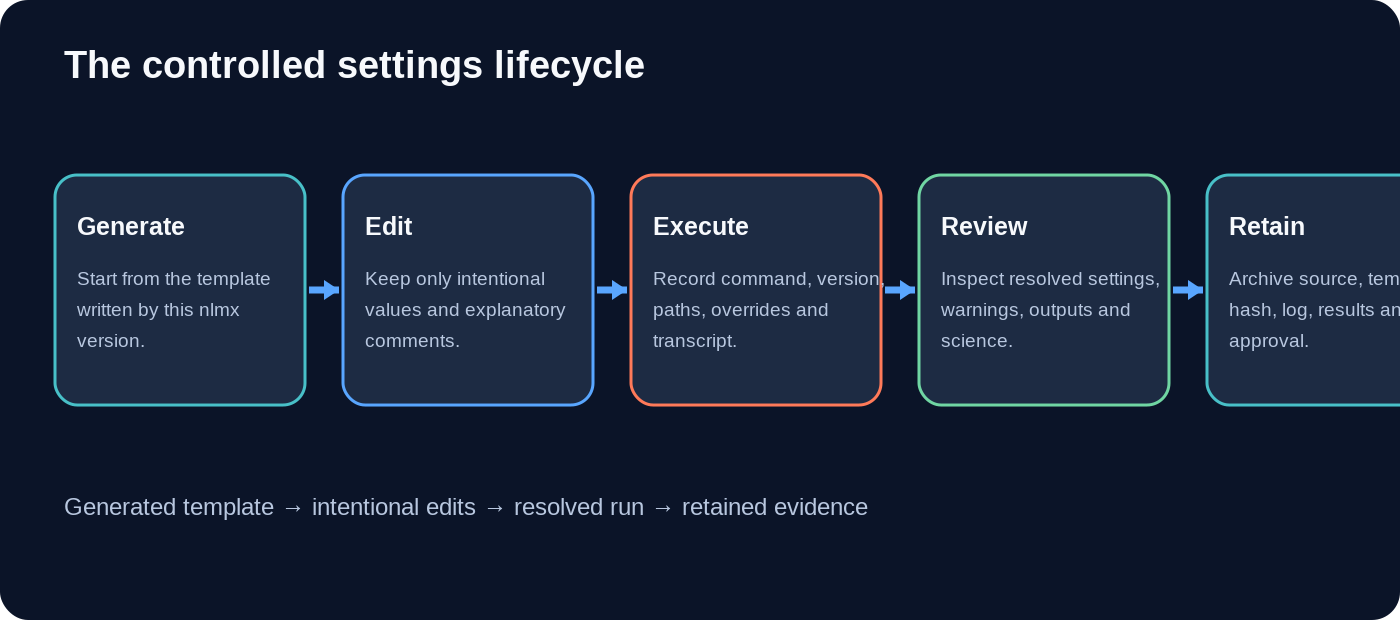
First identify the input population and artifact version. Second, delete or leave commented every option you do not intend to control. Third, edit one table at a time and keep short comments explaining study-specific values. Fourth, run into a new disposable folder and verify resolved inputs, paths, warnings and output count. Fifth, compare the result with the scientific question and expected behavior. Finally, retain the settings, command transcript and reviewed outputs together.
What validation can and cannot prove
Parsing proves that TOML syntax and recognized keys are acceptable. Command validation may prove that referenced data and values satisfy implemented checks. Neither proves that the selected population, endpoint, method, threshold or model is scientifically justified. That judgment belongs in the analysis plan and review record.
The exact generated snapshot is available at documents/ch37/reference/templates/nlmx.custom.
Navigation
See the previous page, next page, and complete settings reference.