31.2 Choosing sse, fim, or both
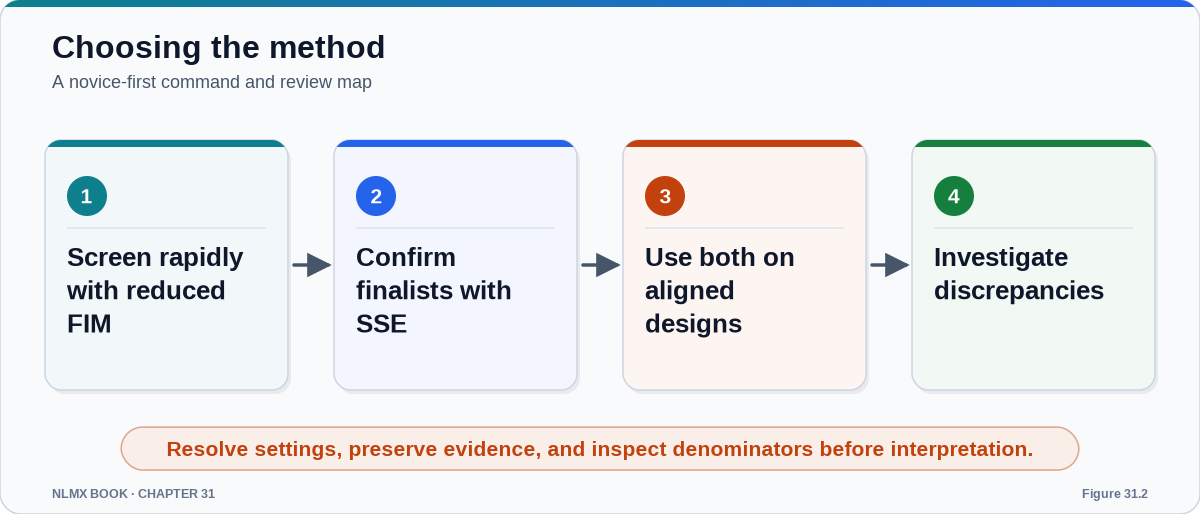
The power meaning of --method is sse|fim|both. The shared 4.16.0 help text incorrectly describes covariate-selection engines; the annotated .power template and validation rules are authoritative.
What the controls mean
- Reduced FIM is a local asymptotic screen for precision and Wald power.
- SSE includes trial generation, fitting, covariance, reduced fits, failures, and Monte Carlo error.
bothruns FIM first and then SSE over the same scenario grid, but unsupported FIM mechanisms may still differ.
The issued command is only the beginning of the audit trail. Always distinguish the reference model, the design template, the resolved scenario, the replicate-specific truth, the fitted result, and the test decision. A value can be correct at one layer and misinterpreted at another.
Command or settings pattern
--method both --fim-kind reduced --replicates 500
Command-line values override settings-file values. Use a fresh folder for an analytical run; preserve the command, resolved settings, log, checksums, and row-level data. Defaults are versioned behavior, so a production protocol should state important values explicitly.
Interpretation and quality control
Compare methods only after aligning truth, schedule, allocation, dropout, missingness, hypothesis, and target. Compliance and BLQ are SSE-only in 4.16.0.
For a novice review, first confirm counts and labels, then inspect numerical values, then ask whether the assumptions represent the proposed clinical study. For an expert review, additionally reconcile aggregates from row-level output, reproduce a subset of trials, and compare the implementation with an independent reference where the claim requires it.
Common mistakes
- Choosing whichever engine gives the smallest N
- Averaging incompatible FIM and SSE estimates
- Reporting a point estimate without its denominator, interval, method, and version
Minimum evidence to retain
- nlmx version, command,
.powerfile, resolved settings, seed, threads, and output checksums; - control stream, design dataset, EXT/COV or parameter sets, and their provenance;
- scenario table, replicate rows and failures, method summaries, plots, report, and interpretation;
- prespecified criteria, Monte Carlo target, validation scope, deviations, and reviewer decisions.
Navigation
See the previous page, next page, and complete command and settings index.