36A.1 Why a pharmacometric analysis ends with a report
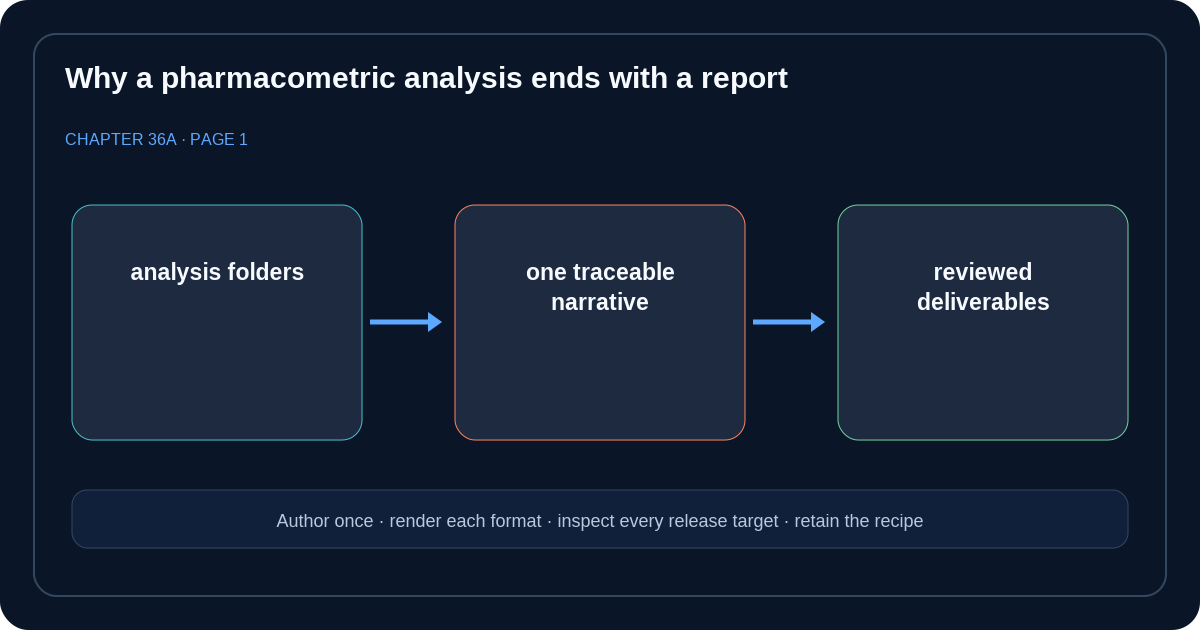
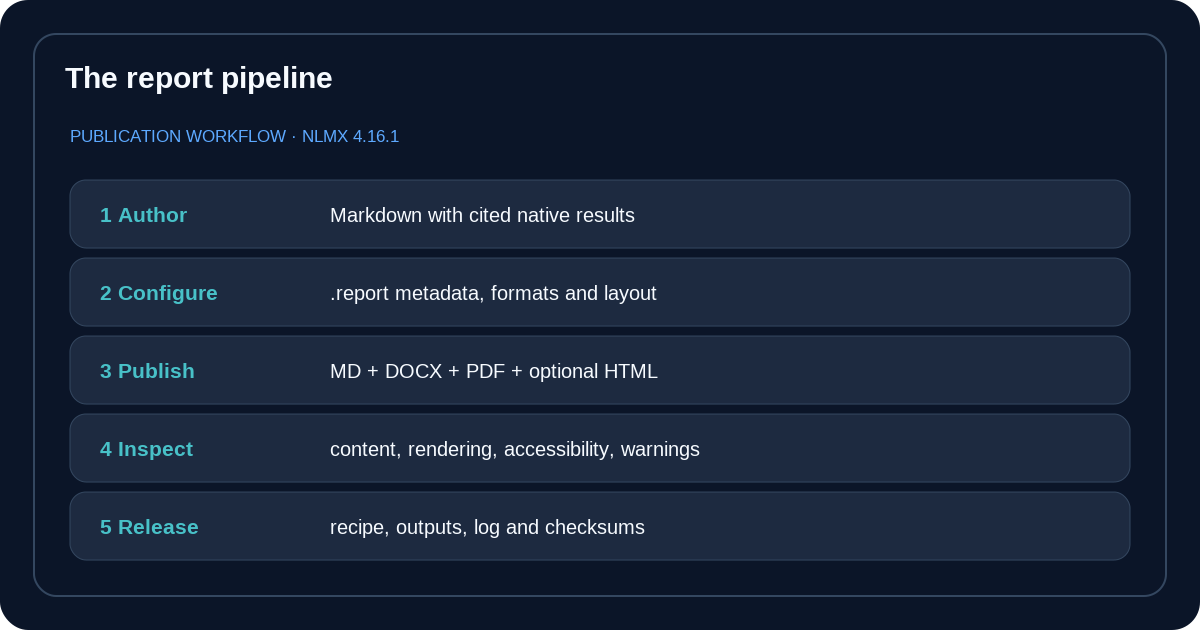
nlmx report publishes one Markdown source into retained Markdown, Word and PDF by default, with optional HTML. The command solves document generation; it does not validate the scientific analysis or approve its interpretation. Treat the source Markdown and .report file as the controlled recipe, and treat every released format as a separate review target.
The final analytical step
An nlmx workflow can produce QC findings, parameter tables, diagnostics, VPCs, covariate decisions, exposure-response models, simulations and power results in separate folders. A reader needs one document that answers the original question without disconnecting the claims from those native files. The report therefore sits after analysis and before release: it selects verified results, explains methods and limitations, records decisions, and points back to evidence.
The central risk is transcription. Retyping a value from memory, redrawing a figure, or manually maintaining Word and PDF copies creates opportunities for disagreement. The safer pattern is one Markdown source whose numbers are read from native CSV/JSON/listing files and whose figures reference the files nlmx generated. nlmx report then renders every requested target from that source.
Publication is not a substitute for analysis review. A polished PDF can contain a failed fit, a wrong population, or an unsupported causal conclusion. Keep three statements distinct: what the command computed, how the author interpreted it, and what the qualified reviewer approved. Record failed or excluded runs rather than silently presenting only a preferred result.
The executed chapter fixture demonstrates the full path from Markdown and .report settings to four outputs. Its values are explicitly illustrative. The executed QA record shows which visual and structural checks were actually completed.
Worked publication sequence
Create report/ beside—not inside—the analysis output folders. Draft report.md, generate study.report, and name a clean deliverables/ output. Before writing conclusions, open the native summaries and make a small source ledger: claim, file, row/field, unit, population and run. Write the summary last so its values have already been checked in the results section. Run report with a log, review warnings, then compare at least three headline values back to their sources. Record which formats were visually reviewed and by whom. If any upstream run changes, treat the report as stale until the ledger, narrative and all formats are rebuilt and rechecked.
Practical review questions
- Does the released content answer the stated question without exceeding the evidence?
- Can every number, table, figure and decision be traced to a retained native file and run?
- Were all generated targets—not merely the source—inspected after the latest change?
- Are warnings, failed runs, limitations and unverified steps visible rather than silently omitted?
- Could another qualified analyst rebuild the same document from the retained recipe?
Navigation
See the previous page, next page, and complete report reference.