Dose, interval, infusion, and dosing compartment
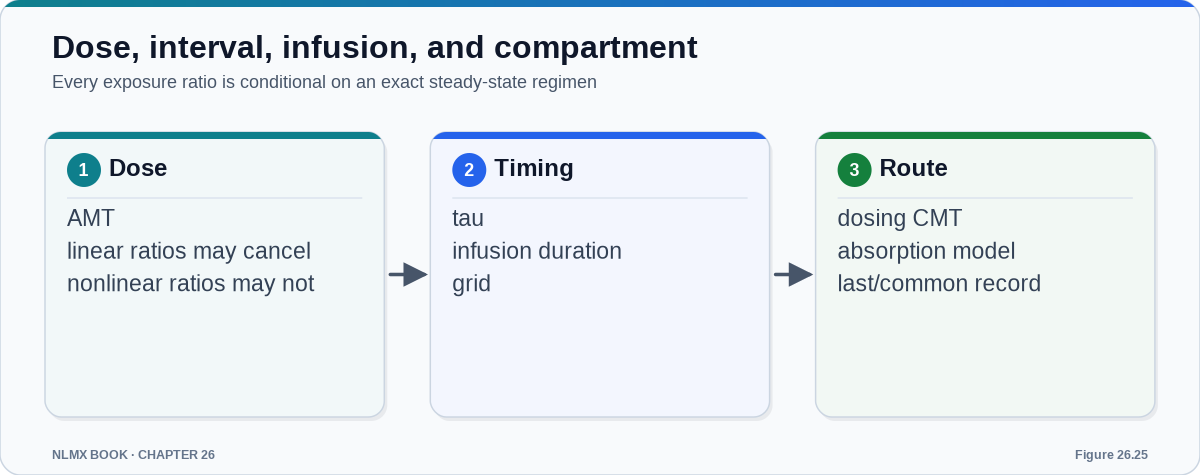
--ss-dose sets amount per administration; --ss-interval sets tau and is required when single-dose data contain no II; --ss-infusion sets duration, with zero representing bolus or first-order input as appropriate; --ss-cmt chooses the dosing compartment. Otherwise nlmx derives them from the regimen records.
Even when ratios appear dose invariant in linear models, state the dose because nonlinearities, bioavailability, target binding, or residual event logic can make it consequential. Interval and infusion strongly influence peaks/troughs and accumulation. The compartment controls route and absorption.
Confirm units against the control stream and dataset. Preserve the console regimen note. A wrong CMT or missing interval can invalidate every exposure row while leaving a polished plot.
Common mistakes
- Treating a forest ratio or reference-band class as covariate-selection evidence, causality, or an automatic dosing recommendation.
- Omitting the reference subject, uncertainty source, regimen, subgroup denominator, data support, or fitted-model diagnostics.
- Confusing parameter-uncertainty intervals, BSV ranges, and subject-bootstrap intervals because they share one graphic.
Page checklist
- The numerator, denominator, fitted model, covariate settings, and units are explicit.
- The interval source and clinical meaning are distinguished from BSV and selection uncertainty.
- Tables, resolved settings, commands, diagnostics, limitations, and confirmation evidence are retained.