20.15 $ESTIMATION, $COVARIANCE, configuration, and precedence
$ESTIMATION supplies approximation and method-specific values. METHOD=0 is FO; METHOD=1 is FOCE, with INTERACTION giving FOCE-I; LAPLACE gives Laplace; METHOD=SAEM activates SAEM. A following METHOD=IMP EONLY=1 supplies importance draws. Without $ESTIMATION, fit defaults to FOCE-I.
$COVARIANCE requests uncertainty and can select R or S; default is sandwich RSR. Command-line options override: --approximation, --max-iterations, --gradient-tolerance, covariance switches/matrix, SAEM controls, seed and IS samples.
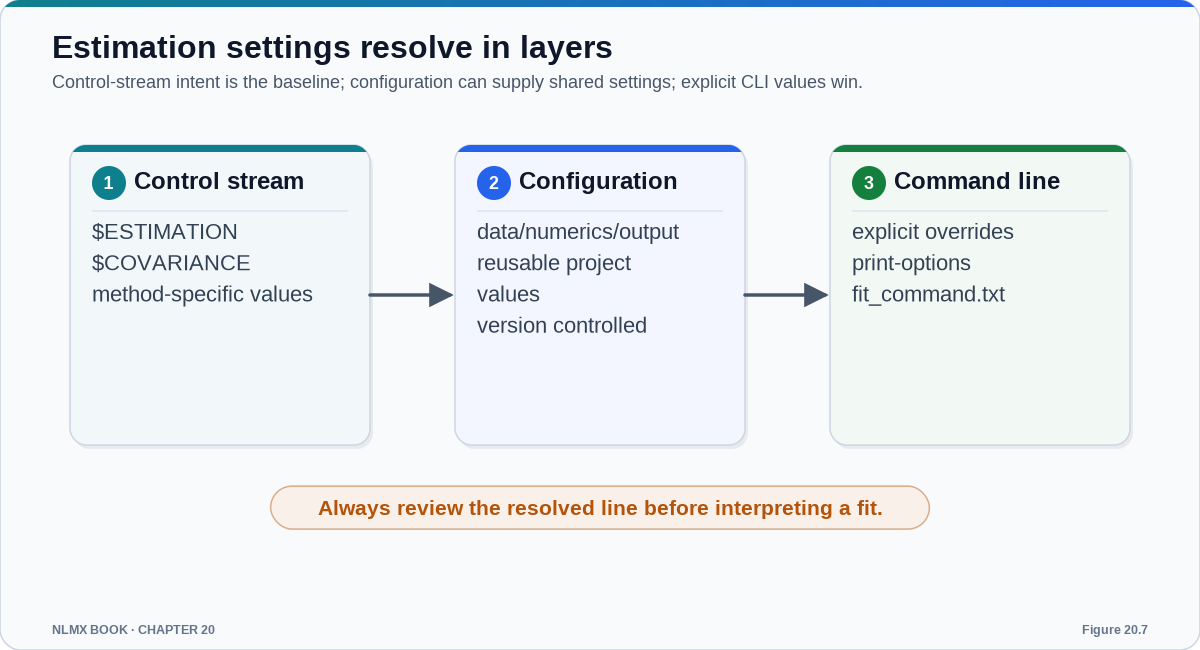
A configuration may supply shared data/numerics/output settings. CLI wins over configuration, which supplements control-stream intent where applicable. --print-options prints every resolved estimation option and stops; the actual fit writes the same resolved line to fit_command.txt.
Do not infer settings from source control alone after overrides. Archive all three layers and the executable version. For comparisons, keep method/numerics fixed unless the change is the explicit question.
Preserve the resolved settings
The effective run is the result of defaults, configuration, control-stream records and CLI overrides. Archive fit_command.txt, the generated final control stream and printed options so a reviewer can see the resolved state. Quoting only the original $ESTIMATION line is insufficient if the command changed method, iterations or covariance behavior.
Use overrides deliberately for controlled experiments. For example, compare FOCE-I and Laplace while keeping the same control and data; do not edit the stream and add a CLI change simultaneously. Once the final method is selected, consolidate or document the authoritative settings so the run does not depend on an undocumented shell history.
Pay special attention to boolean inversions such as --cov-step/--no-cov-step and table/plot suppression. A configuration file can make a command appear simpler while hiding material choices. --print-options is therefore an important audit and troubleshooting tool.
Common mistakes
Do not assume $COVARIANCE ran when --no-cov-step overrides it, call METHOD=1 FOCE-I without INTERACTION, or compare SAEM trace objective to classical OFV.
Checklist
- Parse every estimation/covariance record.
- List configuration values.
- Record CLI overrides.
- Save print-options/fit_command.
- Freeze settings across comparisons.
Further reading
See complete option index, Chapters 18–19, and listing interpretation.