24.18 Complementary pairs and PFER theory
Complementary-pairs stability selection randomly splits subjects into two disjoint halves. Both halves are fitted, so every subject contributes once per pair while selection instability between independent halves is exposed. The subject fraction is effectively 0.5 even if another fraction is configured.
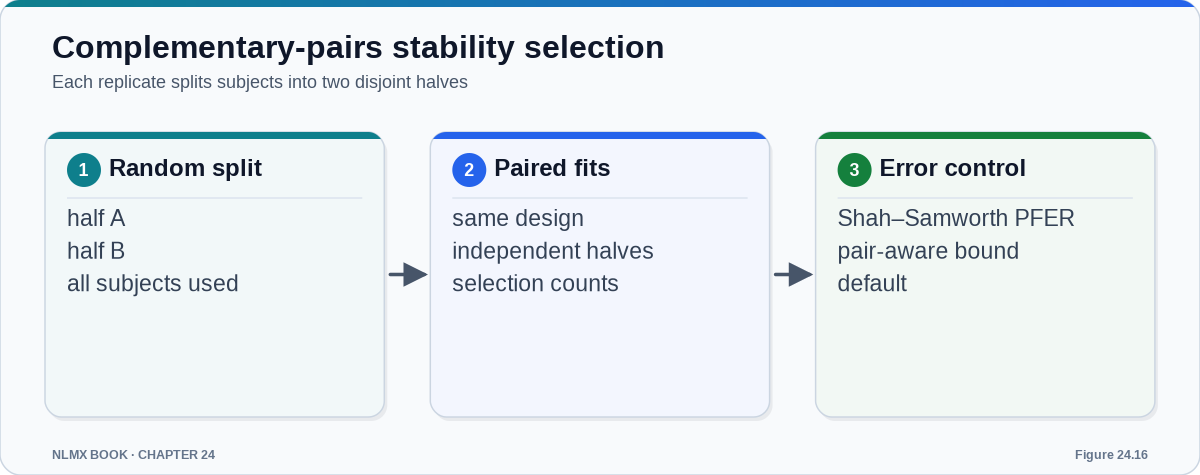
The default Shah–Samworth PFER bound uses complementary-pair structure to estimate an upper bound on the expected number of false selections. nlmx reports average selected-set size, bound at the configured threshold, target, and the threshold required to meet the target. The bound can be loose with few candidate groups.
A PFER warning does not automatically invalidate probabilities, but it prevents an unqualified error-control claim. Use pfer_enforce, calibrated FDR, a stricter threshold, or a revised scope when formal control is required.
Common mistakes
- Treating one split as 200 independent full samples.
- Setting subject fraction other than 0.5 and assuming it applies.
- Calling a reported loose bound exact false-positive count.
- Ignoring average selected-set size.
- Claiming PFER control when the bound exceeds target.
Checklist
- Report paired halves and effective units.
- Review selected-set size and PFER bound.
- State whether control is report-only or enforced.
- Increase replicates for stable probability intervals.
- Validate error rates in simulation.
Further reading
See error control and classification.