Worked example: threshold sensitivity
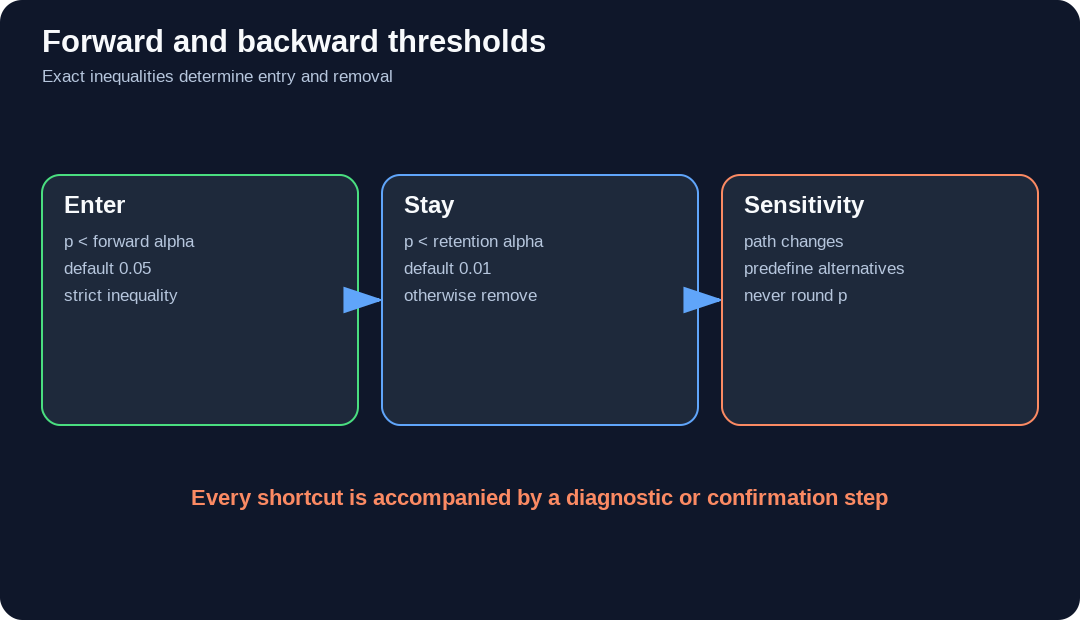
A prespecified strict sensitivity changed forward alpha from 0.05 to 0.01 and retention alpha from 0.01 to 0.001, while using full candidate refits. V–WT, CL–WT, and CL–EGFR still entered because their conditional p-values were well below 0.001; both SEX effects remained unsupported.
The result shows margin from the chosen thresholds for these strong simulated effects. It does not show that 0.01/0.001 is generally superior, nor does it address weak clinically important effects. Threshold changes alter both the path and the implicit multiplicity behavior, so primary and sensitivity settings should be declared before execution.
Report threshold sensitivities as a matrix of direction, cap, entry/retention rules, endpoint, OFV, coefficients, convergence, and interpretation. Avoid presenting only the run that best matches expectations.
Common mistakes
- Treating a stepwise p-value as clinical importance or causal proof.
- Reading a candidate comparison without its active model, convergence state, degrees of freedom, and exact threshold.
- Reporting only the terminal relationship list while discarding failed models, path decisions, configuration, and provenance.
Page checklist
- The scientific question, model identities, and comparison direction are explicit.
- Numerical validity is reviewed before interpreting statistical evidence.
- The result is linked to the complete trace and final joint-model diagnostics.