24.21 Adaptive elastic net: the primary learner
Adaptive elastic net combines L1 sparsity with L2 stabilization and feature-specific penalty weights. nlmx searches alpha values 0.5, 0.75, 0.9, and 1.0 and a 40-lambda path by default, with cross-validation and the conservative one-standard-error selection rule.
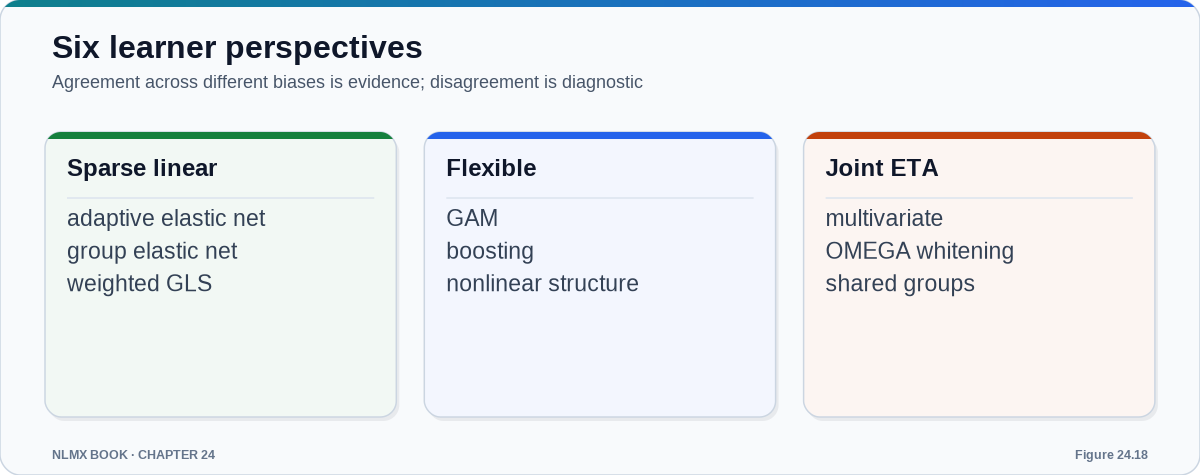
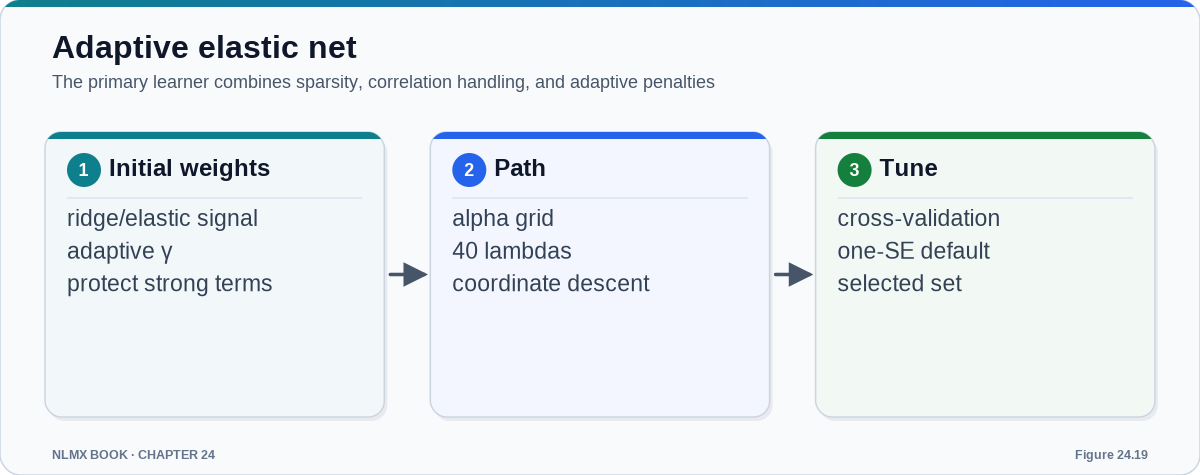
L1 penalty selects features; L2 penalty helps correlated predictors remain numerically stable. Adaptive weights reduce penalty on features supported by an initial fit. The result still depends on scaling, CV folds, lambda grid, sample size, and correlated proxies.
Because it is the default primary learner, its selection frequency drives pair probability classification. Alternative learner agreement is a separate gate, not an average probability.
Common mistakes
- Treating elastic-net coefficients as unbiased effect estimates.
- Ignoring the one-SE versus minimum-CV rule.
- Comparing probabilities after changing scaling or alpha grid.
- Assuming correlated proxies receive unique causal attribution.
- Reporting the primary learner without alternative agreement.
Checklist
- Record alpha/lambda grids, rule, folds, tolerance, and iterations.
- Verify standardized features.
- Inspect convergence and selected-set size.
- Review proxy clusters and alternative learners.
- Use final refit for effect magnitude.
Further reading
Continue with group elastic net, cross-validation, and stability metrics.