41.17 Case 4: iteration limits, evaluate-only, and reading the ending
What you will learn
- Classify any fit ending as converged, not completed or evaluation only from its termination line.
- Use an iteration limit deliberately, and an evaluate-only run to reproduce an OFV without optimising.
- Know which endings produce standard errors and which do not.
- Build a one-line reading habit for every fit summary.
Prerequisites: 41.13, 41.14 and 41.16.
The question: what do the different endings of a fit mean, and what may be done with each?
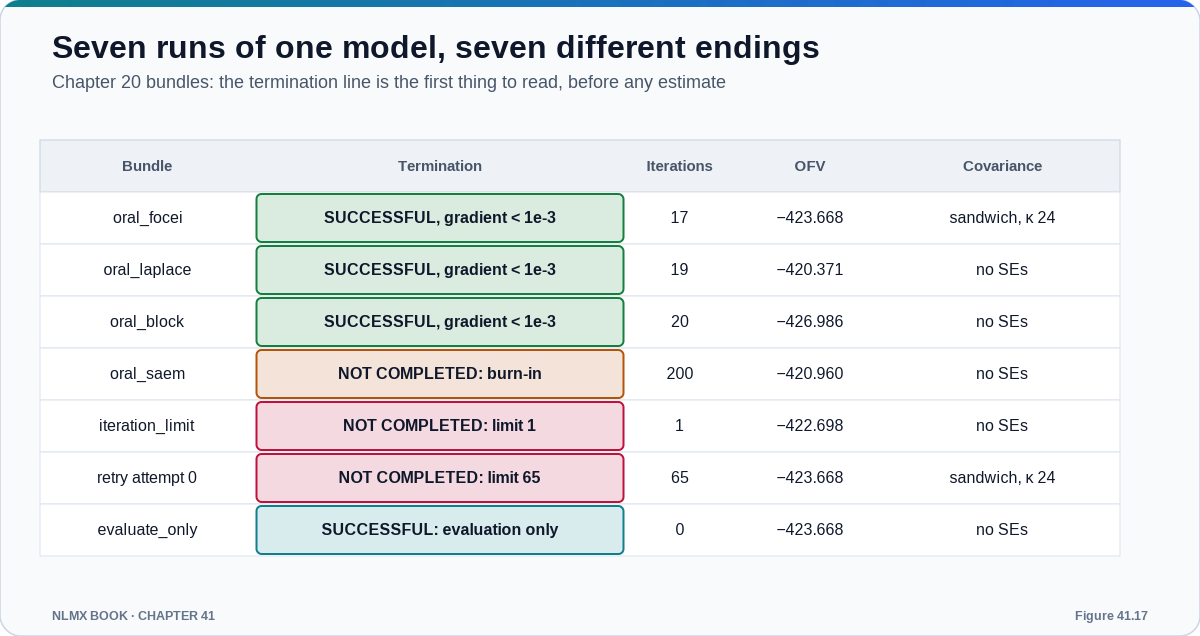
The evidence: seven Chapter 20 bundles that fit the same one-compartment oral model with different settings: oral_focei, oral_laplace, oral_block, oral_saem, iteration_limit, the retry bundle's attempt 0, and evaluate_only.
One model, seven endings
The figure lists them; the termination line distinguishes them.
| Ending | Termination text | Meaning |
|---|---|---|
| Converged | MINIMIZATION SUCCESSFUL — followed by the reason (for example gradient below 1.0e-3, no further decrease possible at a near-zero gradient, or relative OFV change below 1.0e-9 for 3 iterations) |
The optimiser met one of its criteria. The result is a candidate for use |
| Not completed: iteration limit | MINIMIZATION NOT COMPLETED — iteration limit (N) reached |
It stopped because the budget ran out. The result is the last point reached |
| Not completed: burn-in | … burn-in reached NBURN=120 without passing the stationarity test |
SAEM's burn-in did not settle; the result is consistent but not demonstrated |
| Evaluation only | MINIMIZATION SUCCESSFUL — evaluation only (MAXEVAL=0) |
No optimisation: the objective was evaluated once at the given values |
Two words are easy to confuse. Successful in the evaluation-only case means the evaluation succeeded, not that a minimum was found.
A deliberate iteration limit
The iteration_limit bundle fits the same model with --max-iterations 1 and no covariance step. It is the cheapest possible demonstration of what an incomplete run looks like:
Termination        : MINIMIZATION NOT COMPLETED — iteration limit (1) reached
Iterations         : 1 (30 objective evaluations)
Final max gradient : 1.843e1 (internal scale)
Initial OFV        : -414.2249
OBJECTIVE FUNCTION VALUE (OFV): -422.6980
Covariance step: not run or not successful (no standard errors)
After a single iteration the OFV is already −422.70, within one unit of the final −423.67, and the estimates are plausible: CL 3.845, V 43.79, KA 1.139. Two things betray the incompleteness: the gradient is 18.4 (against 0.0001 for the converged run), and there are no standard errors. The lesson is that a plausible-looking table is not evidence of convergence; the termination line and the gradient are. A run with a limit of 1 is useless for inference, but it is exactly what you see when a limit is set too low by habit (for example, a global default that was meant for quick tests) and nobody reads the first line of the summary.
Evaluate only
evaluate_only runs the model with MAXEVAL=0: one objective evaluation, zero iterations, at the starting values of the control stream. Here the starting values are the final estimates of the FOCE-I fit, and the OFV comes out exactly:
Termination : MINIMIZATION SUCCESSFUL — evaluation only (MAXEVAL=0)
Iterations  : 0 (1 objective evaluations)
OBJECTIVE FUNCTION VALUE (OFV): -423.6680
−423.6680 equals the FOCE-I OFV to all printed digits. This is the cheapest and most useful reproduction check in the toolkit. Given a stored control stream with final estimates (for instance, one retrieved from an archive, or produced by another tool), an evaluation-only run tells you in a fraction of a second whether the program, on the data, gives the objective you were told. If it does, the model and the data are the same; if it does not, the difference is in the data, the model code or the approximation, and none of them has to be debugged by re-estimating.
It also answers a different question without any optimisation: how good is this set of values for this data? That is how one tests a literature model or a colleague's estimates on a new data set.
Which endings give standard errors?
| Ending | Standard errors | Why |
|---|---|---|
| FOCE-I converged | yes (sandwich) | the covariance step ran |
| Laplace converged | no (this run) | covariance step not run or not successful |
| SAEM | no (this run) | not completed; no covariance step |
| Iteration limit 1 | no | covariance step disabled |
| Retry attempt 0 | yes | the covariance step ran on the last iterate |
| Evaluate-only | no | there is no minimum to take the curvature at |
The retry row deserves a second look: standard errors exist but the fit is not converged. The two properties are independent, and the termination line is the one that decides whether the result may be used.
The one-line reading habit
Before reading a single estimate, read in this order:
- Termination — did it converge, run out, or only evaluate?
- Iterations and gradient — how close to the criterion?
- Covariance step — which estimator, which condition number?
- Notes — boundaries, excluded records, anything the program wanted to say.
- Then the estimates.
The five lines take ten seconds and prevent the worst mistake in the chapter: building on the table of a run that did not finish.
The decision
| Question | Evidence | Decision | Reversible? |
|---|---|---|---|
| Which of the seven runs may be reported as the model? | terminations | oral_focei (converged, SEs); the retry winner is equivalent |
yes |
| What are the others for? | endings | Laplace and SAEM: robustness evidence; iteration limit: demonstration only; evaluate-only: a reproduction check | yes |
What this case does not show
A failure that ends the process (a non-positive-definite OMEGA, an unsupported feature) never produces this kind of summary; it ends with an error and a documented exit code, the subject of Chapter 39 and of the validation fixtures of page 42.14.
Review checklist
- Is the termination line the first thing you read?
- Do you know the difference between not completed and evaluation only?
- Is the iteration limit in your settings one you set on purpose?
- Do you keep an evaluate-only run as the reproduction check of every reported model?
Navigation
See the previous page, the next page and the complete case-study reference.