37.35 Compatibility, aliases, deprecated structures, and interface drift
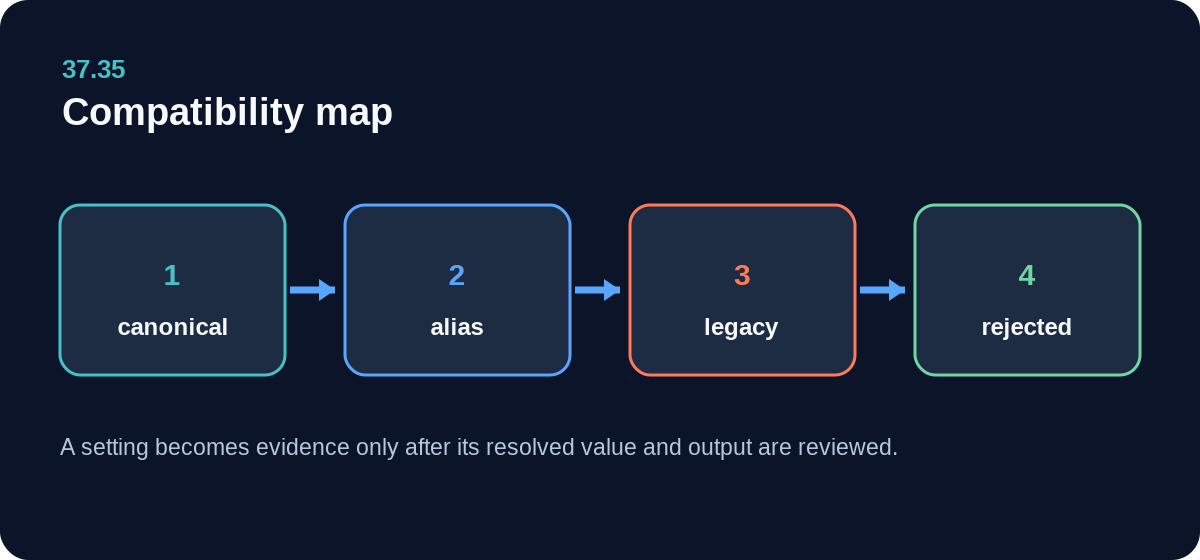
Settings compatibility is more than TOML syntax. A file can parse correctly yet use a removed table, an old token, a command alias or a path convention that no longer represents the intended analysis.
Canonical forms in 4.16.2
Use the command-specific extension from the registry and generate a fresh template. Current command aliases include run for cov, qc for qc-data, and example for generate; use canonical command names in controlled scripts even when an alias remains accepted. Within .covar, canonical learner names are gam, boosting and multivariate. Compatibility spellings accepted by the implementation include spline_gam, penalized_spline_gam and pspline_gam for gam; gradient_boosting and boosted_trees for boosting; and several multivariate legacy tokens. Canonicalize these during a reviewed migration rather than relying indefinitely on translation.
Configuration version 1 versus 2
The .covar loader recognizes version numbers 1 and 2, but the current strict document checker rejects the former [data], [model] and [[parameters]] tables and instructs the user to delete them, set config_version = 2, and let nlmx read structure and estimation information from the control stream. Therefore, “version 1 is recognized” must not be interpreted as “every old version-1 document runs unchanged.” Test the actual file.
[[covariates]] forms is canonical; allowed_forms is an accepted alias, but supplying both is an error. Ridge controls under [score] are accepted as aliases for their numerical counterparts where the generated schema notes this. Alias acceptance should be treated as a transition aid, not proof that two historical releases behaved identically.
Known documentation-interface drift
The 4.16.2 extension registry contains .custom and .report, and both commands generate and consume those settings files. Some older global help/configuration summaries still list the earlier set without them. The command-specific help, generated template, extension registry and executed behavior are stronger evidence for those formats. Similarly, the generated .covar header lists frozen, posterior and both beside method, while command help and implementation accept scm; the same template later mentions method = "scm". This chapter records the inconsistency rather than silently correcting the snapshot.
Rejected spellings are valuable guardrails
Unknown tables and keys are rejected. Wrong extensions are rejected. This prevents a typo from silently selecting a default, but it means migrations must classify every error: removed concept, renamed concept, wrong table, wrong type, unsupported value or path problem. Do not “fix until it runs” without recording what each edit means scientifically.
Navigation
See the previous page, next page, and complete settings reference.