16.28 Worked example: one-compartment oral data
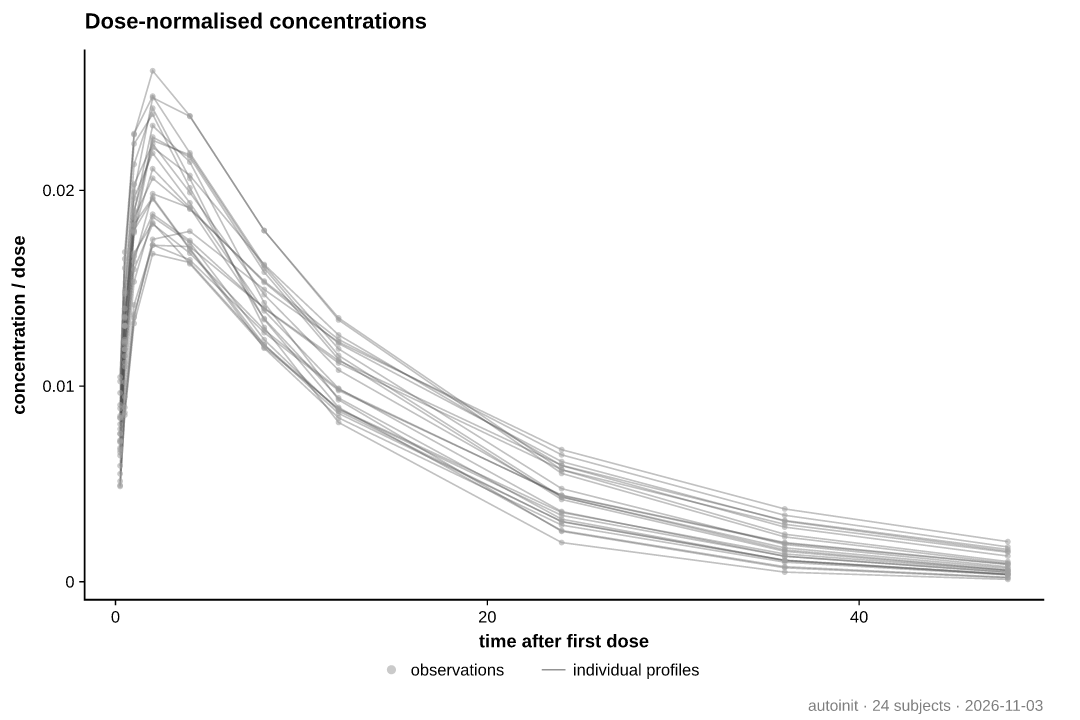
This fixture contains 24 subjects given 100 mg orally with ten rich samples through 48 hours. Subject CL, V, and KA vary deterministically; concentration curves are exact one-compartment profiles.
Files:
Results
All three methods contribute. Recommended CL is about 3.043, V about 40.622, and KA about 1.465, close to generating typical values 3, 40, and 1.4. NCA KA is higher than NLS/ML because Tmax and terminal approximations differ, but the methods remain on the same scale.
The exact one-compartment curves fail the dataset-level two-compartment criterion. V1/Q/V2 are therefore explicitly labelled rules of thumb rather than fitted structural estimates. Proportional residual error reaches the 0.03 floor because no random residual noise was added; this demonstrates a safeguard, not assay truth.
Review workflow
Open the CL/V histograms and compare their spread with OMEGA source. Inspect individual method rows and NCA acceptance. Then check one- and two-compartment blocks: only the first has direct structural support, while the others are candidates for later screening.
Run NCA-, NLS-, and ML-only sensitivity directories. Their recommendation columns should equal the selected method and conditional files should follow method selection.
Common mistakes
- Calling rule V1/Q/V2 recovered parameters.
- Interpreting the residual floor as observed variability.
- Expecting NCA/NLS/ML to be numerically identical.
- Reporting starts as final population results.
Checklist
- Confirm 24 subjects and oral route.
- Compare all method values and sources.
- Identify rule-of-thumb structure rows.
- Review OMEGA distributions.
- Use later screen/fit to estimate final parameters.
Further reading
See recommendation rules, one-compartment NLS, initial-estimates schema, and Chapter 17 in the plan.