Validation, reporting, and the complete SCM checklist
Validation proceeds from small to large: unit checks for model-set keys and chi-square p-values; synthetic datasets with known true/null effects; candidate-cap comparisons; direction and threshold sensitivities; cache/resume equivalence; failure injection; and cross-engine NONMEM/PsN comparisons. Performance claims require runtime and hardware evidence alongside selection accuracy.
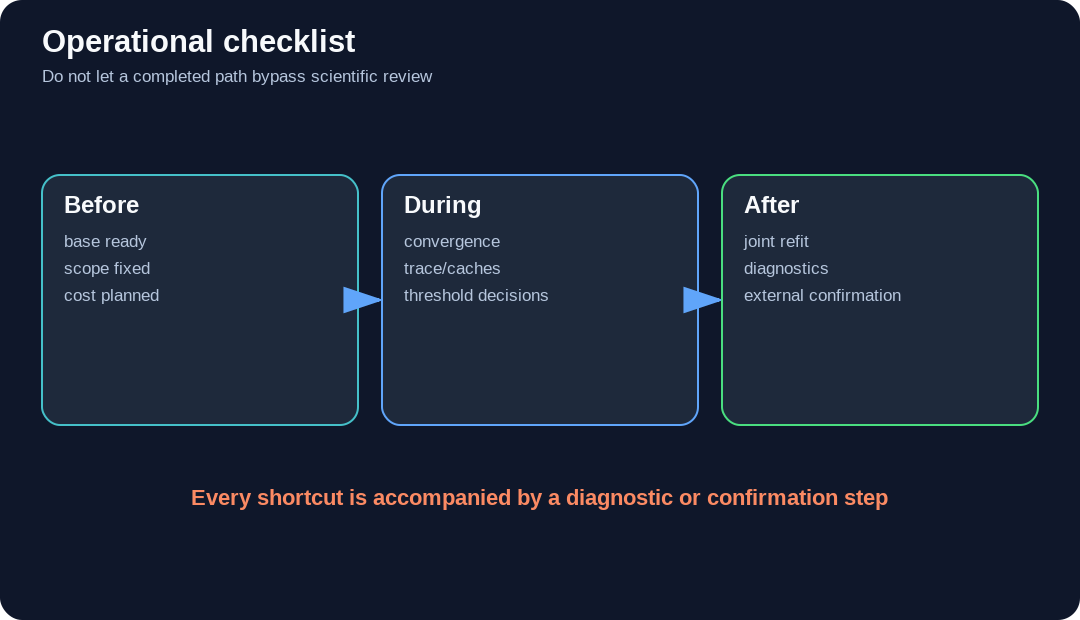
A complete report states software/version, inputs and hashes, base readiness, scope, types/forms/references, missing policy, forced/excluded terms, direction, thresholds, candidate cap, approximation, numerical controls, every failed refit, full trace, final model, uncertainty, diagnostics, sensitivities, and known limitations. It separates statistical selection from clinical relevance and dosing decisions.
Release gates should require deterministic outputs where promised, checksum-complete bundles, no unexplained endpoint disagreements on the frozen suite, bounded numerical differences, and documented failure behavior. SCM completion is the beginning of model qualification—not the end.
Common mistakes
- Treating a stepwise p-value as clinical importance or causal proof.
- Reading a candidate comparison without its active model, convergence state, degrees of freedom, and exact threshold.
- Reporting only the terminal relationship list while discarding failed models, path decisions, configuration, and provenance.
Page checklist
- The scientific question, model identities, and comparison direction are explicit.
- Numerical validity is reviewed before interpreting statistical evidence.
- The result is linked to the complete trace and final joint-model diagnostics.