34.16 Failures, changed corrections, and stopping rules
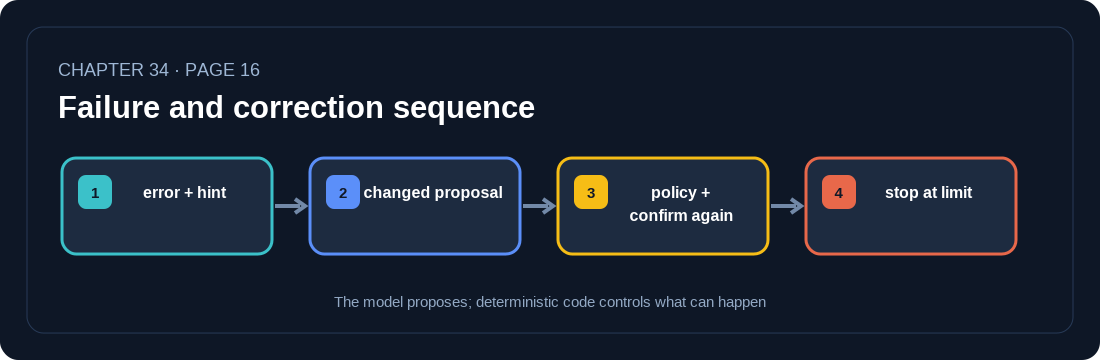
A failed child command returns its error lines and hint to Maxson. A correction may change a path, column, option, value, or settings file, but it is a new proposal: policy checks and confirmation apply again. Unchanged repeats are blocked, and prior settings versions are retained.
How the mechanism works
Corrections are for command formulation, not silent analysis redesign. Changing endpoint, covariate set, estimation method, or scientific objective requires the user’s decision. fix_attempts sets a hard limit; timeout/internal errors stop the request.
Evidence from nlmx 4.16.1
Audit events distinguish fix_attempt, repeated_failure, result status, and end state. A session process can exit 0 while a child failed or a proposal was refused; the transcript makes that visible.
What the mechanism protects—and what it does not
The mechanism controls a defined part of the workflow. It does not make the model’s prose correct, select the right scientific question, validate external data, or transfer accountability away from the user. Treat policy safety, computational success, statistical adequacy, and scientific validity as separate conclusions.
Review practice
When a correction changes scientific meaning, stop and ask. Review the diff between settings versions, not just the final file. Repeated errors can indicate wrong assumptions, missing inputs, or unsupported workflow—not merely syntax needing another guess.
For a novice, read the human transcript first, then the JSONL event log, exact settings/commands, and native command outputs. “The session completed” describes the outer process only; individual proposals may have been planned, declined, refused, failed, corrected, or executed.
Evidence to retain
- nlmx version/build, backend identity,
.asksettings, policy, limits, and system prompt; - request, raw replies, help/manual/file context events, confirmations, refusals, and corrections;
- every settings version and exact executed command, with child exit status and full output;
- reviewer interpretation, unresolved warnings, scientific limitations, and final disposition.
Navigation
See the previous page, next page, and guardrail, policy, and audit index.