Audience, prerequisites, and the novice ramp
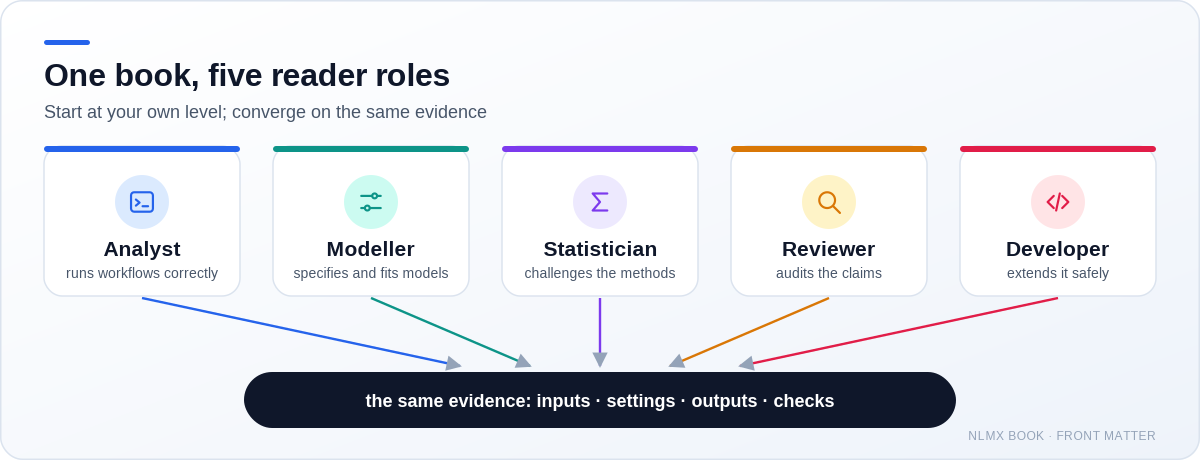
This book is written for people who create, use, review, or maintain pharmacometric evidence. It does not assume prior nlmx experience. It explains commands from a novice starting point, while keeping enough detail for an experienced modeller to challenge methods and reproduce a run.
Who this book is for
| Reader | Typical question | Start with | Evidence to retain |
|---|---|---|---|
| Pharmacometrician | “How do I build, fit, evaluate, and communicate this model?” | Chapters 3–10, then the task chapter | model/data/settings, run logs, diagnostics, uncertainty, review record |
| Clinical pharmacologist | “Does this model support the dosing or development decision?” | Chapters 1, 3, 14, 21, 26–33 | estimand, population, exposure/response summaries, sensitivity analyses |
| Statistician or data scientist | “What is estimated, under which approximation, and with what uncertainty?” | Chapters 8–9, 18–19, 22–24, 30, 32 | equations, assumptions, diagnostics, simulations, acceptance criteria |
| Reviewer or validator | “Can I trace the claim to controlled inputs and independently checked outputs?” | Chapters 9–10, 18, 38–40; planned Chapter 42 | versions, hashes, requirements, tests, deviations, approvals |
| Software developer | “What contract must a change preserve?” | Chapters 8–9, 36–39; planned Appendix D | source/test version, fixtures, tolerances, schemas, changelog |
A person often occupies more than one role. The important distinction is the question being asked. An analyst deciding whether to retry a fit needs operational detail; the same person reviewing a dose recommendation needs an intended-use and uncertainty perspective.
What the book assumes
The book assumes basic familiarity with:
- concentrations, doses, time, clearance, volume, half-life, and exposure;
- rows and columns in a delimited dataset;
- the idea that a model has parameters estimated from observations;
- basic command-line navigation: opening a terminal, changing folders, and running a program;
- reading a plot, a table, and a text log.
Familiarity with NONMEM vocabulary—control streams, $INPUT, $DATA, $PK, $ERROR, $THETA, $OMEGA, $SIGMA, .ext, .cov, .phi, objective function value—is helpful but not required. Chapters 4–8 introduce the shared concepts and file structures. Mathematical pages use algebra, probability, matrices, likelihoods, and asymptotic reasoning; the notation page in this front matter supplies the symbols, and planned Appendix A will consolidate the mathematical background.
What you do not need
You do not need to know any programming language, own NONMEM, run a language-model server, or understand every estimation algorithm before completing the guided tour. Some optional capabilities have extra prerequisites; their pages state them. A novice can use supplied or generated examples while learning how each artifact is connected.
You also do not need to memorise options. Command chapters begin with complete option indexes and link settings keys to their command-line equivalents. Use help and generated templates rather than relying on memory.
A novice learning ramp
Stage 1 — vocabulary and safe execution
Read the rest of the front matter, Chapter 1, and Chapter 4. Learn the difference between a project, a run family, an output directory, a warning, and a failure. Run nlmx --version and nlmx <command> --help before working on a real project.
Stage 2 — a complete synthetic tour
Use Chapter 3. The goal is not to master every method. It is to see how a dataset, control stream, settings, output folder, tables, figures, and logs fit together. Keep the generated project separate from regulated or proprietary data.
Stage 3 — data before model
Read Chapters 6, 11, 12, and 13. Practice identifying observation and dose records, time ordering, missing values, BLQ handling, covariate types, and control-stream/data mismatches. A sophisticated model cannot repair a misunderstood dataset.
Stage 4 — model and estimation
Read Chapters 8, 16–20, and 21. Learn structural prediction, random effects, residual error, likelihood approximations, starting values, convergence, covariance, shrinkage, and goodness-of-fit diagnostics. Reproduce a small known example before fitting a complex study.
Stage 5 — advanced workflows
Choose the task-specific route: covariates (Chapters 22–26), model evaluation (Chapter 27), simulation and power (Chapters 28–31), exposure-response (Chapters 32–33), assistant workflows (Chapters 34–35), or reporting (Chapter 36A).
Minimum technical setup for hands-on reading
- an nlmx executable that you can identify with
nlmx --version; - a terminal or PowerShell window;
- a plain-text editor with UTF-8 support;
- a web browser for HTML reports;
- a safe working folder where outputs may be created;
- enough disk and memory for the chosen example;
- the matching release documentation and example data.
The software is designed to run without NONMEM and without a network for its core workflows. The built-in assistant may use an embedded model or a configured local server; assistant chapters explain its separate dependencies and guardrails.
How the book relates to shorter guides
| Source | Best use | Limitation |
|---|---|---|
nlmx <command> --help |
exact installed command syntax | intentionally short; does not teach the method |
--print-config / schema |
exhaustive current settings and allowed values | tells what is accepted, not what is scientifically appropriate |
docs/*.md |
focused quick reference for one command | less tutorial and cross-workflow context |
README.md |
project overview, building, capabilities, licence, citation | broad rather than method-complete |
| this book | novice teaching, rationale, interpretation, cross-links, review checklists | must be matched to its stated software version |
CHANGELOG.md |
what changed and when | change summary, not a full replacement manual |
When exact installed syntax and a book example differ, first compare versions. Generate current help and templates, then consult the matching changelog. Report unresolved inconsistencies using the errata template.
A self-check before moving on
You are ready for Chapter 1 if you can answer these questions:
- Which nlmx version will you use, and how will you preserve that identity?
- Which folder may the example write into?
- What is the difference between a warning and a failure?
- Where will you look for exact command syntax?
- Who will independently review a result before it supports a decision?
If any answer is unclear, that is normal. Record the question and revisit it after Chapter 3. The purpose of the guided tour is to turn these abstractions into visible files.
Navigation
See the preface, continue to reading paths, or begin the full sequence with Chapter 1.