Categorical covariates, levels, and labels
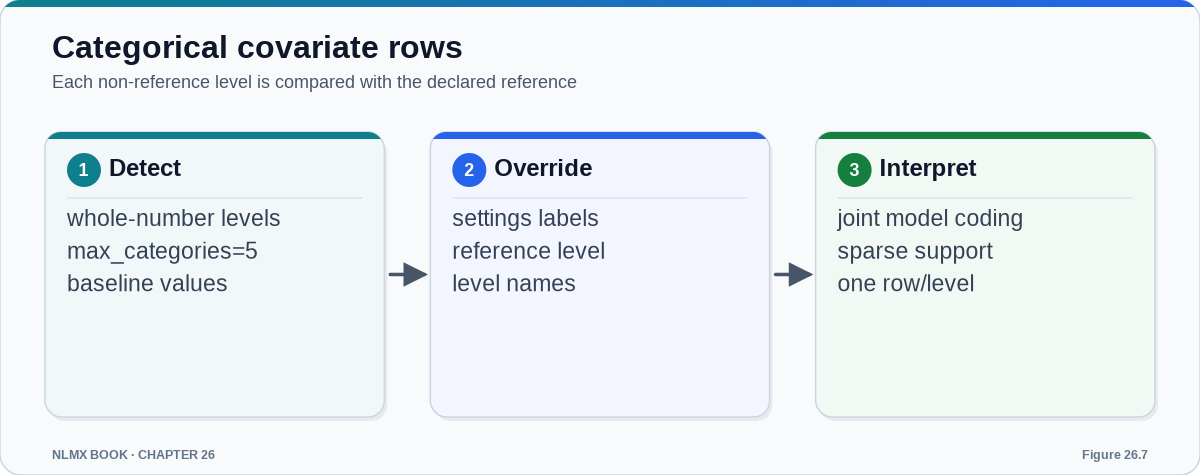
A baseline covariate with no more than max_categories distinct whole-number values (default five) is treated as categorical. The most frequent level is the default reference, and each non-reference level becomes a row. Settings can override reference and provide human-readable level labels.
Use --level-labels "SEX=0:Male,1:Female" for presentation, but preserve the numeric coding and reference in machine-readable outputs. Sparse levels can generate unstable fitted effects and wide intervals even when the plot looks simple. Review counts and model diagnostics.
If an integer variable is actually continuous or ordinal beyond automatic detection, set it explicitly in the model/data workflow; forest interpretation cannot correct a wrongly fitted covariate equation. A categorical row is conditional on all other covariates being at their references.
Common mistakes
- Treating a forest ratio or reference-band class as covariate-selection evidence, causality, or an automatic dosing recommendation.
- Omitting the reference subject, uncertainty source, regimen, subgroup denominator, data support, or fitted-model diagnostics.
- Confusing parameter-uncertainty intervals, BSV ranges, and subject-bootstrap intervals because they share one graphic.
Page checklist
- The numerator, denominator, fitted model, covariate settings, and units are explicit.
- The interval source and clinical meaning are distinguished from BSV and selection uncertainty.
- Tables, resolved settings, commands, diagnostics, limitations, and confirmation evidence are retained.