Reading the selection trace
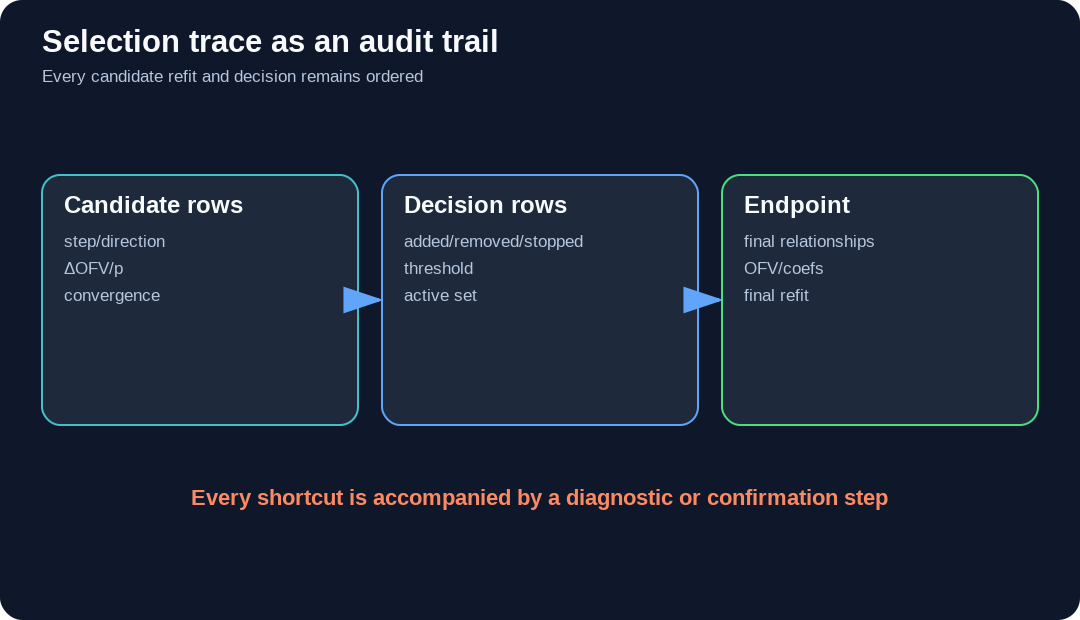
The selection trace is the chronological explanation of the search. It records base stationarity context, direction and thresholds, candidate refits, ΔOFV and p-values, additions/removals, stopping rules, final relationship set, and final-refit summary. Read it from top to bottom; identical p-values at different steps can represent different conditional models.
Candidate rows describe comparisons. Decision rows explain which comparison changed the active set. A stop row proves the stage reached an algorithmic endpoint. For backward-only, selection_step=0 can identify the full-model start; it is not the final result. The refit_dofv/refit_p associated with a retained relationship may describe its last step comparison, not a universal comparison against the original base.
Reconcile the trace with candidate_results.csv, equations.csv, the refit cache (frozen_refits.json), and final model. Any mismatch in relationship keys, directions, df, or endpoint is a validation failure, not a cosmetic reporting issue.
Common mistakes
- Treating a stepwise p-value as clinical importance or causal proof.
- Reading a candidate comparison without its active model, convergence state, degrees of freedom, and exact threshold.
- Reporting only the terminal relationship list while discarding failed models, path decisions, configuration, and provenance.
Page checklist
- The scientific question, model identities, and comparison direction are explicit.
- Numerical validity is reviewed before interpreting statistical evidence.
- The result is linked to the complete trace and final joint-model diagnostics.