21.30 Complete diagnostic checklist and reporting template
Use this checklist for a final fit review. Adapt it prospectively to the analysis purpose rather than deleting failed items after seeing results.
Run and population
- Record nlmx version, command, control/data hashes, method, seed, and output bundle.
- Verify convergence, gradient, objective, covariance status, boundaries, and condition diagnostics.
- Reconcile source rows, subjects, observations, events, FFLAG records, EXCL rows, MDV, and DVID.
- State predose, missing, censoring, filtering, and transformation policies.
Population and individual predictions
- Review DV–PRED for intercept, slope, curvature, clusters, and changing spread.
- Review DV–IPRED without treating it as independent validation.
- Compare by time, prediction, endpoint, study, dose, route, occasion, and prespecified clinical strata.
- Inspect sparse and decision-critical ranges explicitly.
Residuals and random effects
- Review RES/IRES in original units and IWRES/WRES/CWRES under their correct definitions.
- Inspect time and prediction trends, distribution, QQ behavior, tails, and subject clustering.
- Review ETA distributions, pairs, OMEGA correlation, ETA/EPS shrinkage, and subject information.
- Trace influential or anomalous subjects to events and source data.
Model adequacy and reporting
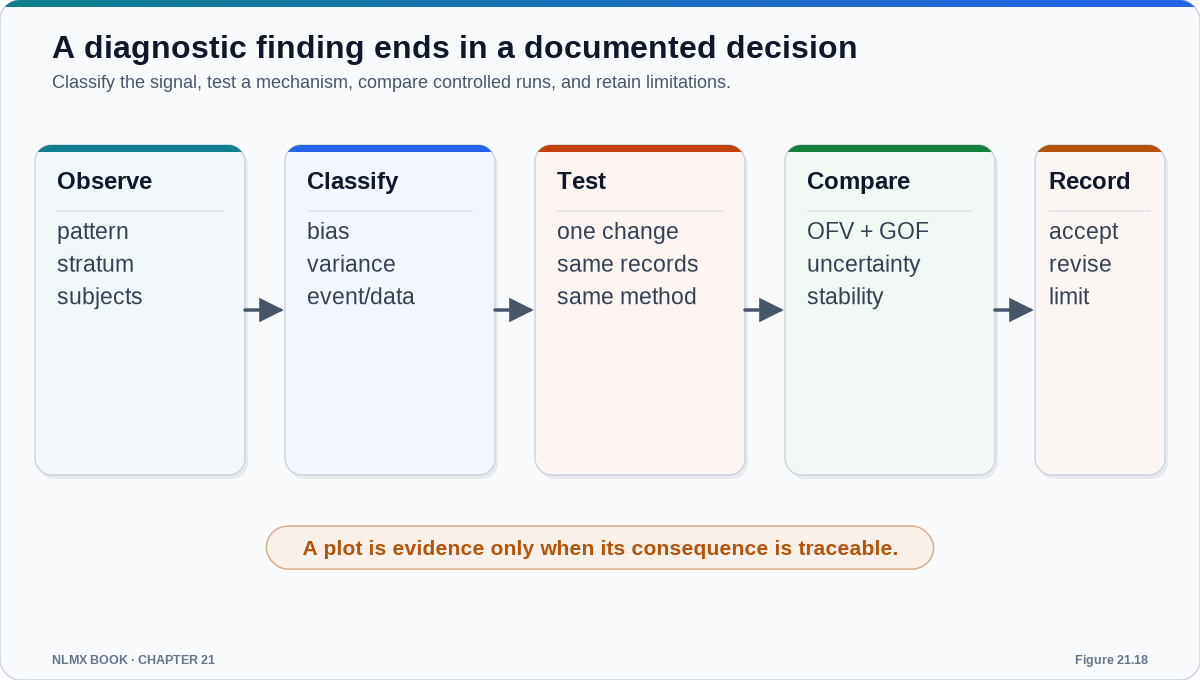
- Link every material finding to a hypothesis, controlled test, and disposition.
- Compare likelihood only under compatible data, method, and objective definitions.
- Integrate uncertainty, boundaries, identifiability, and clinical consequences.
- Add VPC or outcome-specific predictive diagnostics where required.
- State known limitations and unsupported extrapolations.
Suggested report wording
The model was evaluated using population and individual prediction plots, conditional and individually weighted residual diagnostics, random-effect distributions and correlations, shrinkage, parameter uncertainty, boundary diagnostics, and prespecified stratification. The review population contained [N] subjects and [N] eligible observations; [N] records were excluded or handled by non-Gaussian likelihood for documented reasons. Material findings were [findings]. Controlled sensitivity analyses showed [results]. The model was judged [adequate/adequate with limitations/inadequate] for [intended use], with limitations in [scope].
Common mistakes
- Reporting “GOF plots were acceptable” without evidence.
- Omitting row accounting and diagnostic population.
- Listing findings without decisions or sensitivity results.
- Claiming validity beyond the observed design.
- Treating this checklist as a substitute for scientific judgment.
Checklist
- Complete every applicable section above.
- Attach figures, machine-readable data, and exact commands.
- Identify exploratory versus prespecified diagnostics.
- Obtain independent review for decision-critical analyses.
- Preserve the final disposition and limitations.
Further reading
Return to the Chapter 21 overview, Chapter 20’s validation guidance, and proceed to Chapter 22 covariate-modelling concepts.