Common versus own regimens
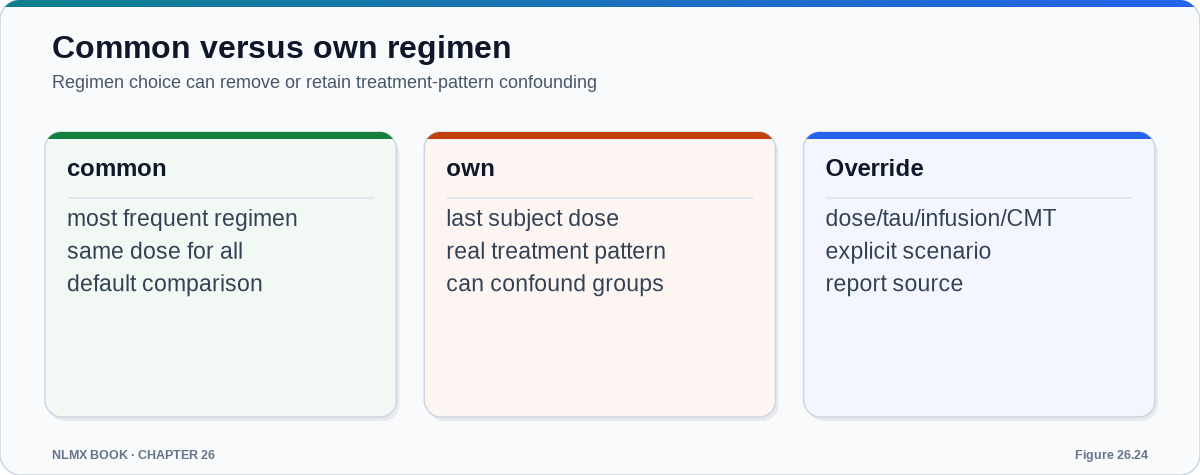
--ss-regimen common is the default. It applies the most frequent dataset regimen to every subject, allowing subgroup exposure comparisons at a common dose, interval, infusion, and compartment. This reduces treatment-pattern confounding and is usually preferred for covariate-effect communication.
own uses each subject's last dose regimen. It describes the observed treatment-plus-patient pattern, which may be clinically useful but can confound exposure differences when dose was adjusted for renal function, weight, response, or toxicity.
Explicit --ss-dose, --ss-interval, --ss-infusion, and --ss-cmt override regimen elements. State whether the analysis is standardized or treatment-pattern descriptive. Sensitivity across common and own regimens is often informative.
Common mistakes
- Treating a forest ratio or reference-band class as covariate-selection evidence, causality, or an automatic dosing recommendation.
- Omitting the reference subject, uncertainty source, regimen, subgroup denominator, data support, or fitted-model diagnostics.
- Confusing parameter-uncertainty intervals, BSV ranges, and subject-bootstrap intervals because they share one graphic.
Page checklist
- The numerator, denominator, fitted model, covariate settings, and units are explicit.
- The interval source and clinical meaning are distinguished from BSV and selection uncertainty.
- Tables, resolved settings, commands, diagnostics, limitations, and confirmation evidence are retained.