Final joint refit and reference confirmation
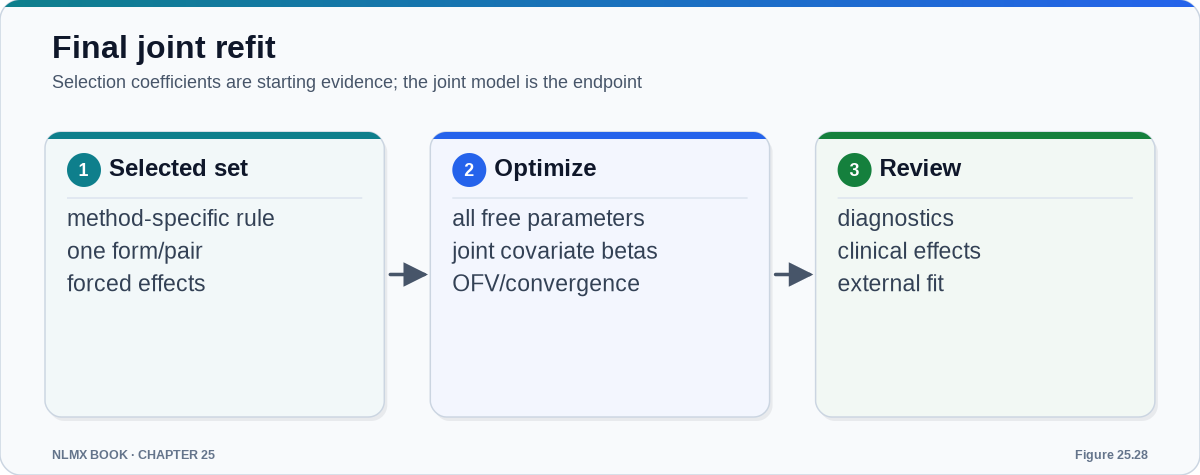
All selection modes jointly refit retained relationships by default. The final refit re-estimates base parameters and covariate coefficients together, providing a fitted OFV, adjusted estimates, and draft model. This is the minimum fitted endpoint for diagnostics, but it remains conditional on the selected set and nlmx likelihood.
Check that the refit's active set matches classifications, convergence and gradients are credible, coefficients/bounds/correlations are plausible, random-effect and residual variability change sensibly, and predictive diagnostics improve without overfit. Translate effects across clinically relevant covariate values and assess support/extrapolation.
Finally execute draft_model.ctl in the target NONMEM workflow with mapped estimation/covariance settings. Define tolerances for OFV, estimates, variability, uncertainty, predictions, and diagnostics. A generated draft is not a NONMEM result until it is actually fitted.
Common mistakes
- Changing the scientific question after seeing the result while presenting it as the original run.
- Reading one engine's summary without checking its prerequisites, failures, normalized settings, and fitted endpoint.
- Treating a generated draft, comparison label, or completed checkpoint as a substitute for model diagnostics and reference-software confirmation.
Page checklist
- The exact command, version, inputs, resolved settings, and output directory are identifiable.
- Engine-specific evidence is interpreted on its own scale before cross-method comparison.
- Recovery state, final refit, diagnostics, and remaining confirmation work are explicit.