39.8 Exit code 6: inconsistent model artifacts
What you will learn
- Reconstruct one coherent run family
- Check parameter/matrix dimensions and labels
- Use hashes and native statuses before numerical reuse
Prerequisites: Chapter 36 exit-code reference, Chapter 38 output completion, and the Chapter 39 overview.
This page describes nlmx 4.16.2. Troubleshooting must preserve the failed attempt: keep its exact command, working directory, log, resolved settings, input/model identities, partial outputs, and process exit code. Correct one causal condition at a time and compare the new evidence with the failed run. Never convert a nonzero exit into success in a wrapper, and never interpret exit 0 as scientific acceptance without the command-native verdict.
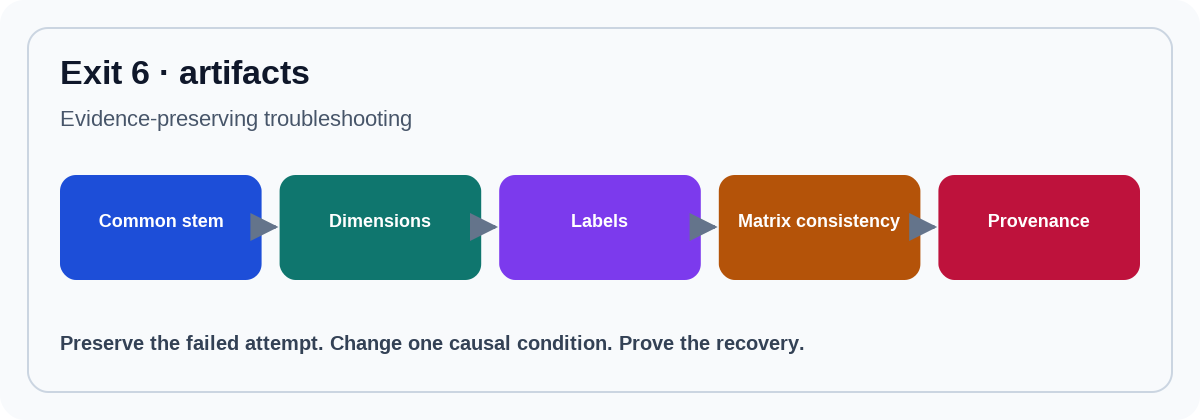
Exit 6 protects against combining files that look plausible but do not describe one fitted model. A NONMEM/nlmx family can include .ctl, .ext, .cov, .cor, .phi, and tables. Matching filenames are not enough: they must share run provenance, model dimensions, parameter labels/order, estimation step, and valid status.
Typical failures include a control stream using more THETAs than the .ext, ETA/OMEGA dimension mismatch, covariance labels that do not map to the model, non-positive covariance diagonal, excessive condition number, disagreement between .cov and .cor, missing required .phi, or ambiguous discovery. These are evidence defects, not numerical nuisances.
Rebuild the family from the original run folder. Record hashes and modification times, inspect final estimation/covariance status, and use explicit file options when multiple stems are present. Never reorder a covariance matrix by intuition, copy a .phi from a similar run, or raise a condition-number gate solely to get past validation.
When the hint allows dropping an optional artifact, document the consequence. Dropping .cor may be reasonable if .cov is authoritative and no consumer requires correlation cross-checking; dropping .cov can disable parameter-uncertainty propagation and changes the analysis. After repair, the input manifest must prove a single coherent family and all dimensions/labels must reconcile.
Page checklist
- Did you retain the exact exit code, stage, message, hint, log, and partial output?
- Did you identify one causal layer before changing anything?
- Is the recovery a new, traceable attempt with the same intended estimand?
- Did you check command-native and scientific acceptance after process completion?
Navigation
See the previous page, next page, and complete error reference.