24.3 Subject posterior means, covariances, and draws
For subject i, nlmx approximates the ETA posterior as N(mᵢ, Vᵢ). The vector mᵢ locates the subject; matrix Vᵢ describes uncertainty and correlation among ETAs. A draw is ηᵢ = mᵢ + Lᵢz, where LᵢLᵢ′ = Vᵢ and z is a standard-normal vector.
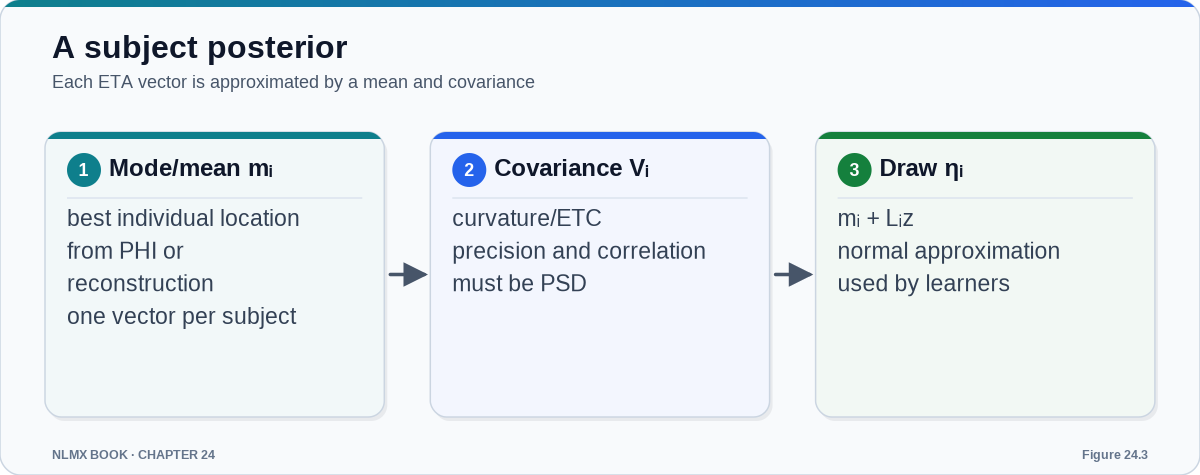
Off-diagonal covariance matters. Drawing each ETA independently would destroy posterior correlation and distort multivariate or shared-covariate evidence. Covariance must be symmetric positive semidefinite and aligned with ETA order. Small numerical defects may be repaired within a strict limit; material defects trigger policy handling.
Posterior normality is a local approximation. Multimodality, boundaries, discrete latent structure, or strong nonlinearity can make it inadequate. Diagnostics should compare posterior moments with OMEGA, report repairs and weak subjects, and test sensitivity to source/approximation.
Common mistakes
- Drawing ETAs independently when V contains correlation.
- Confusing OMEGA with each subject's posterior covariance.
- Treating a local normal approximation as exact.
- Mismatching ETC columns and ETA order.
- Ignoring covariance repair size.
Checklist
- Verify mean/covariance source and ETA labels.
- Preserve within-subject correlations in draws.
- Review eigenvalues, repairs, and weak-subject counts.
- Check the posterior moment identity.
- Escalate non-Gaussian or boundary cases.
Further reading
Continue with source policies, PHI/ETC, and repair gates.