16.5 Route detection per dose and mixed designs
Route is decided per dose because one subject can receive oral, bolus, and infusion treatments across periods. The decision affects simulations, apparent versus systemic parameters, F1, and generated model blocks.
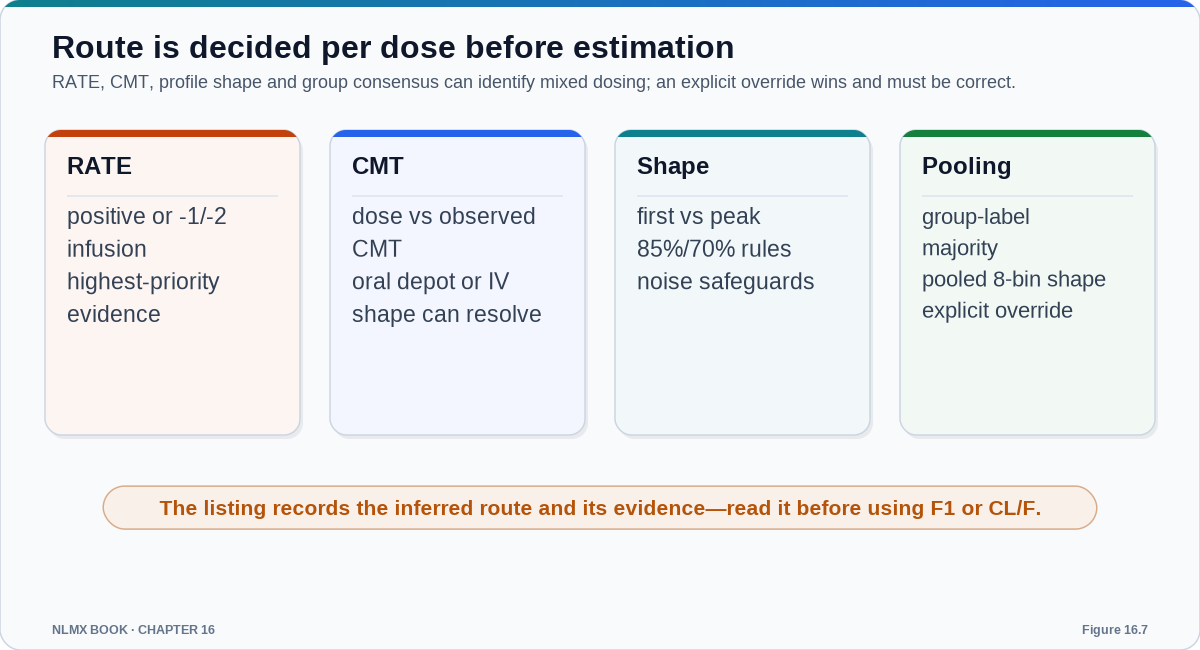
Automatic evidence
A positive RATE, or supported special rate coding, identifies infusion. For non-infusion doses, measurable samples before the next dose are examined. A profile is rising when the peak is not the first sample and the first value is below 85% of the peak; the first value below 70% defines a clearer rise used to distinguish absorption from noise.
With CMT, dosing into a different compartment from most observations supports extravascular input. A dose into the observed compartment supports IV bolus unless the profile rises. Majority rules across comparable doses stabilize classification: at least 80% agreement can classify the set, while noise safeguards prevent small fluctuations around an IV peak from being called absorption.
Without CMT, dose records are pooled by group label. Undecided profiles may use a pooled, dose-normalised eight-bin group shape when enough observations exist. With no usable evidence, extravascular is the fallback.
Explicit controls
--route auto|oral|iv|bolus|infusion|mixed overrides the decision policy. oral means extravascular but positive RATE remains infusion. mixed requires CMT to distinguish routes. bolus ignores RATE, so use it only when that is genuinely correct.
The listing prints counts and reasons. Review them against protocol. A shape algorithm is not more authoritative than verified administration records.
Common mistakes
- Setting one route for a crossover with IV and oral periods.
- Treating a noisy IV curve as oral because a later point is slightly higher.
- Ignoring CMT convention differences between datasets.
- Using bolus override on actual infusions.
Checklist
- Verify route per dose against protocol.
- Inspect RATE, CMT, and early profile shape.
- Read the printed route evidence and counts.
- Use group labels when CMT is absent.
- Confirm F1 and apparent/systemic naming afterward.
Further reading
See group pooling, F1 and mixed routes, and crossover example.