Worked example: both-direction SCM
The primary worked run used nlmx 4.8.0, the Chapter 22 fitted base, CL=WT,EGFR,SEX;V=WT,SEX, power equations for continuous covariates, proportional equations for SEX, direction both, forward alpha 0.05, retention alpha 0.01, and the default cap of three refits per forward step.
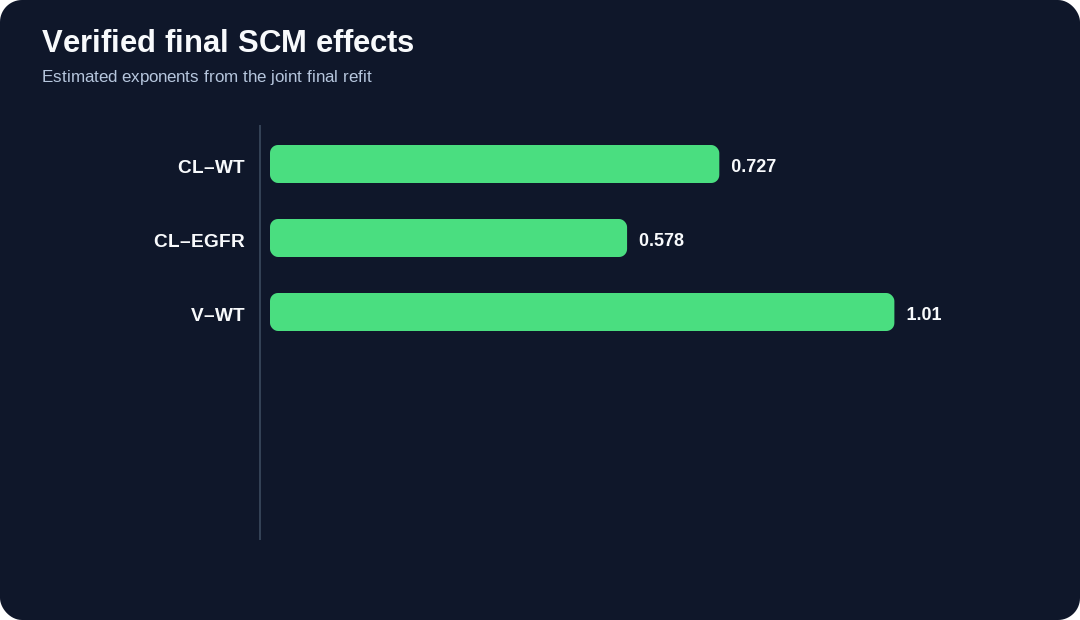
V–WT entered first (ΔOFV=40.764, p=1.718×10⁻¹⁰), CL–WT second (18.542, 1.662×10⁻⁵), and CL–EGFR third (15.947, 6.516×10⁻⁵). At step four, CL–SEX (p=0.7388) and V–SEX (0.4003) failed entry. All three active effects passed the backward 0.01 rule. Final OFV was −1157.8135, with exponents 0.72682, 0.57762, and 1.01002 respectively.
The run therefore recovered the three simulated effects and rejected both null SEX relationships. That is a controlled verification result, not evidence that every dataset will recover truth. The preserved command and result directory permit exact inspection.
Common mistakes
- Treating a stepwise p-value as clinical importance or causal proof.
- Reading a candidate comparison without its active model, convergence state, degrees of freedom, and exact threshold.
- Reporting only the terminal relationship list while discarding failed models, path decisions, configuration, and provenance.
Page checklist
- The scientific question, model identities, and comparison direction are explicit.
- Numerical validity is reviewed before interpreting statistical evidence.
- The result is linked to the complete trace and final joint-model diagnostics.