34.2 Architecture and trust boundaries
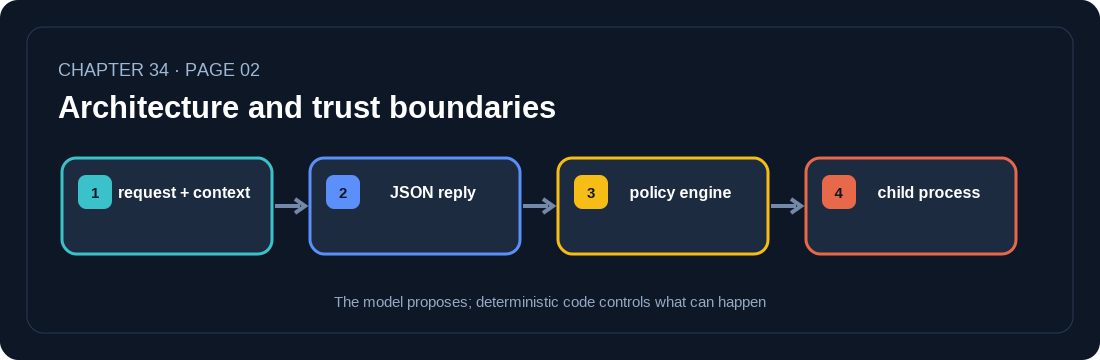
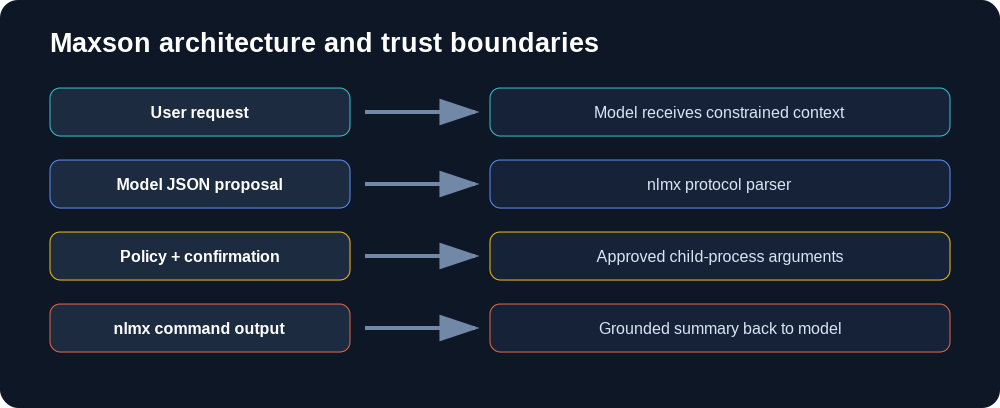
The architecture has a conversational boundary, a protocol boundary, a policy boundary, and a process boundary. The backend may be embedded, local-server, or mock, but all proposals pass through the same parser and policy before execution. The backend never receives a general shell handle.
How the mechanism works
The system prompt contains behavior instructions, protocol, current command catalog, session facts, and selected manual/file content. The reply parser turns JSON into typed fields. The policy converts an approved step into exact arguments and a fresh output directory. The execution layer starts the nlmx child process with a timeout.
Evidence from nlmx 4.16.1
The assistant is organized into separate parts for the protocol, policy, command execution, results, session, settings, templates, files, manual, catalog, and backends. This separation is a review aid: persuasive language cannot directly bypass deterministic checks.
What the mechanism protects—and what it does not
The mechanism controls a defined part of the workflow. It does not make the model’s prose correct, select the right scientific question, validate external data, or transfer accountability away from the user. Treat policy safety, computational success, statistical adequacy, and scientific validity as separate conclusions.
Review practice
A trust-boundary diagram should be reviewed against code and configuration for the installed version. An architectural separation reduces attack surface, but configuration choices such as remote servers or confirm="none" still change risk.
For a novice, read the human transcript first, then the JSONL event log, exact settings/commands, and native command outputs. “The session completed” describes the outer process only; individual proposals may have been planned, declined, refused, failed, corrected, or executed.
Evidence to retain
- nlmx version/build, backend identity,
.asksettings, policy, limits, and system prompt; - request, raw replies, help/manual/file context events, confirmations, refusals, and corrections;
- every settings version and exact executed command, with child exit status and full output;
- reviewer interpretation, unresolved warnings, scientific limitations, and final disposition.
Navigation
See the previous page, next page, and guardrail, policy, and audit index.