36.2 Finding help and the authoritative interface
This chapter is a lookup reference for nlmx 4.16.1. Option tables are generated from the installed release executable. Read an option in the context of the command page: nlmx uses a global parser, but an accepted option can be irrelevant to a command unless its help text names that command or the command's method chapter defines the behavior.
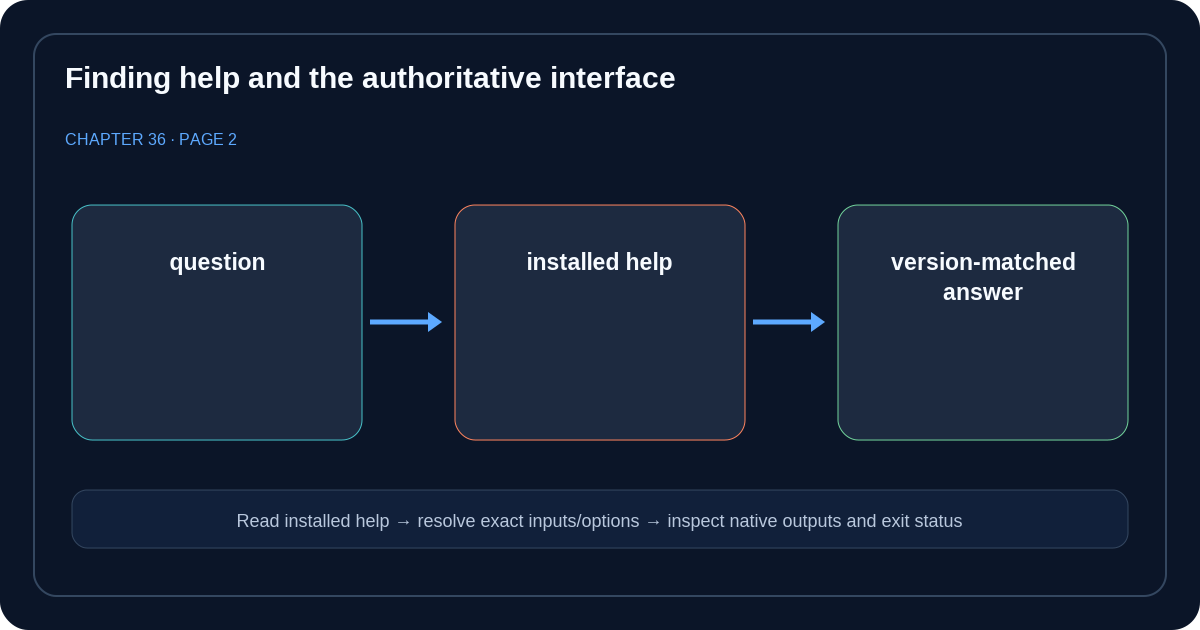
The safe sequence is: identify the installed version, open that command's help, freeze input/settings/output paths, run into a new or empty output directory, inspect both the process status and the command-native verdict, and retain the log/resolved settings/checksums. A command line is reproducible only when its referenced files and software version are also frozen.
The authoritative lookup order
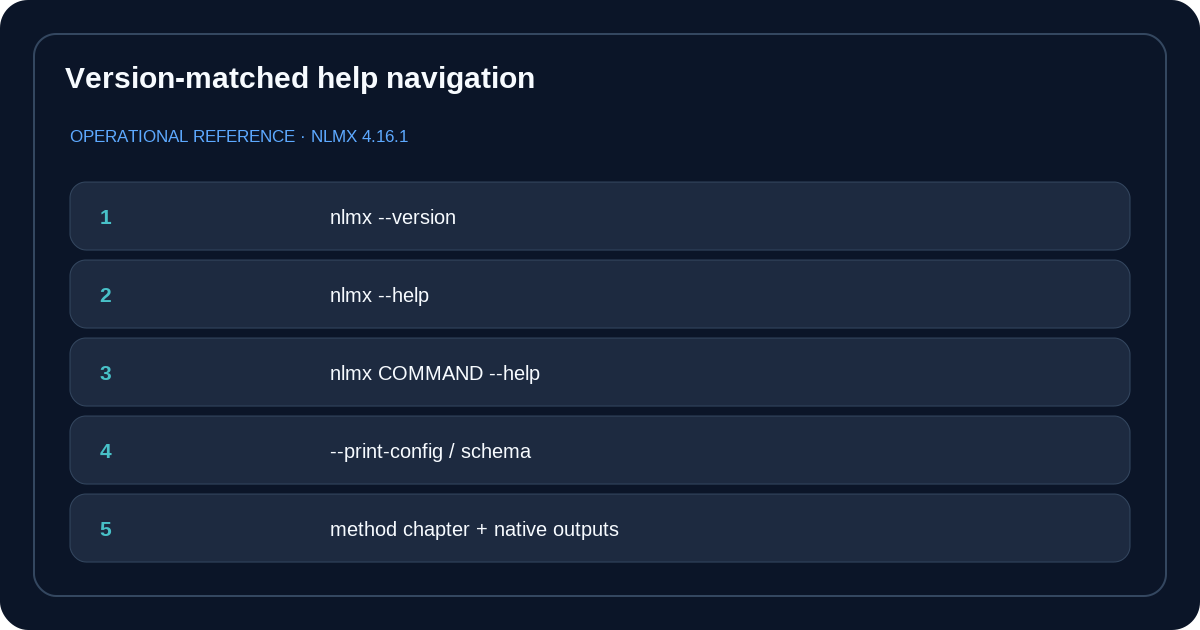
- Run
nlmx --versionand record the version. - Use
nlmx --helpfor the command tree and global catalogue. - Use
nlmx COMMAND --help(ornlmx help COMMAND) for the installed command page. - For commands with settings, generate the annotated template with
--print-configor usenlmx schemafor.covar. - Use the method chapter for interpretation, then inspect native result files.
-h may be shorter than full help in some command-line tools; in nlmx the supported lookup is shown by installed help. The reference snapshots preserved with this chapter are evidence for 4.16.1, not a replacement for checking a different installed binary.
Aliases remain useful for old scripts but should not be chosen for new documentation: run maps to cov, qc maps to qc-data, and example maps to generate. Prefer canonical command names so logs, help searches, and review conversations use one vocabulary. Unknown options are usage errors; options accepted globally but irrelevant to the selected command should be removed rather than retained as misleading noise.
Novice review checklist
- Can you identify the exact installed nlmx version and canonical command?
- Are positional inputs, named options, settings, and output paths unambiguous?
- Did you distinguish parser acceptance from command-specific meaning?
- Will the run preserve enough native evidence to determine semantic success?
- Is a qualified human decision required after the software completes?
Navigation
See the previous page, next page, and complete command index.