23.1 Role and accuracy contract
The frozen engine is a screening accelerator. Its main scientific question is: “At the completed base solution, is there local evidence that a specified covariate coefficient should move away from zero?” It is not identical to asking which fully re-estimated model has the lowest objective function, because population parameters and variance components do not traverse a new optimum for every screen.
The accuracy contract has four parts. First, the base model must be correctly mapped and close to a stationary point under the nlmx likelihood. Second, efficient information must remain numerically usable after nuisance adjustment. Third, a candidate's effect must be locally approximable around coefficient zero. Fourth, important or borderline findings must be escalated through refinement, final refitting, SCM, or external confirmation.
The engine is particularly attractive for a broad prespecified scope, repeated simulation studies, rapid sensitivity work, and prioritization of expensive refits. It is less suitable as sole evidence when effects are large, candidates are strongly correlated, covariate forms are highly nonlinear, variance parameters are near boundaries, the base fit is unstable, or a regulatory conclusion depends on a marginal threshold.
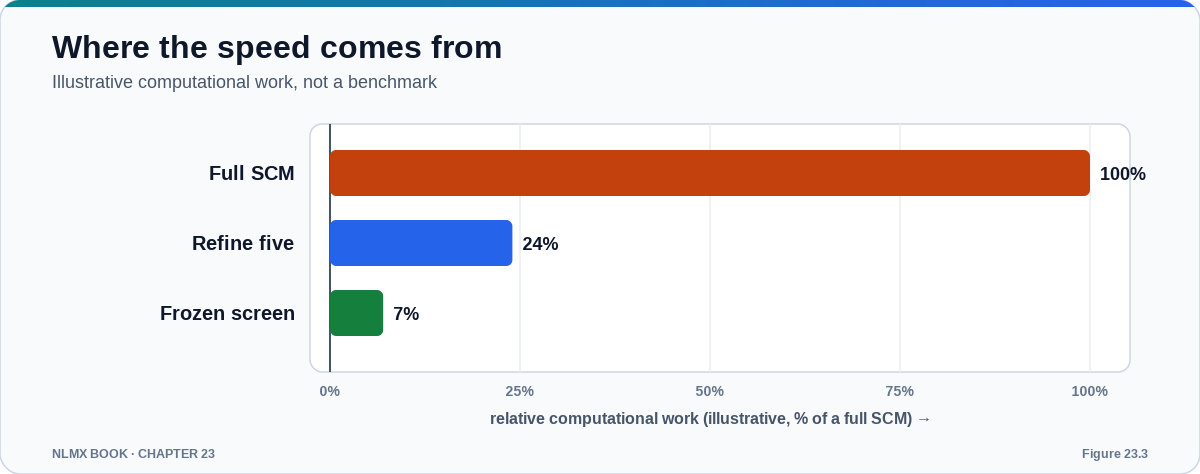
Speed and accuracy are therefore not competing slogans. Speed comes from reusing base work and replacing repeated optimization with derivatives. Accuracy is maintained by diagnostics, calibration, uncertainty propagation, targeted refits, and a declared escalation policy.
Common mistakes
- Calling frozen selection a drop-in reproduction of every NONMEM/PsN SCM path.
- Treating a small score p-value as a final effect estimate.
- Using the engine to rescue an inadequate base model.
- Reporting speed without the number of candidates, subjects, approximation, and confirmation work.
- Interpreting
uncertainas evidence of no relationship.
Checklist
- State the screening question and intended downstream confirmation.
- Define the candidate family before analysis.
- Verify base-model and information diagnostics.
- Escalate material or borderline results.
- Qualify accuracy claims against versioned reference analyses.
Further reading
Continue with what is frozen, the accuracy envelope, and Chapter 40 when drafted.