Score-ranked acceleration and its accuracy envelope
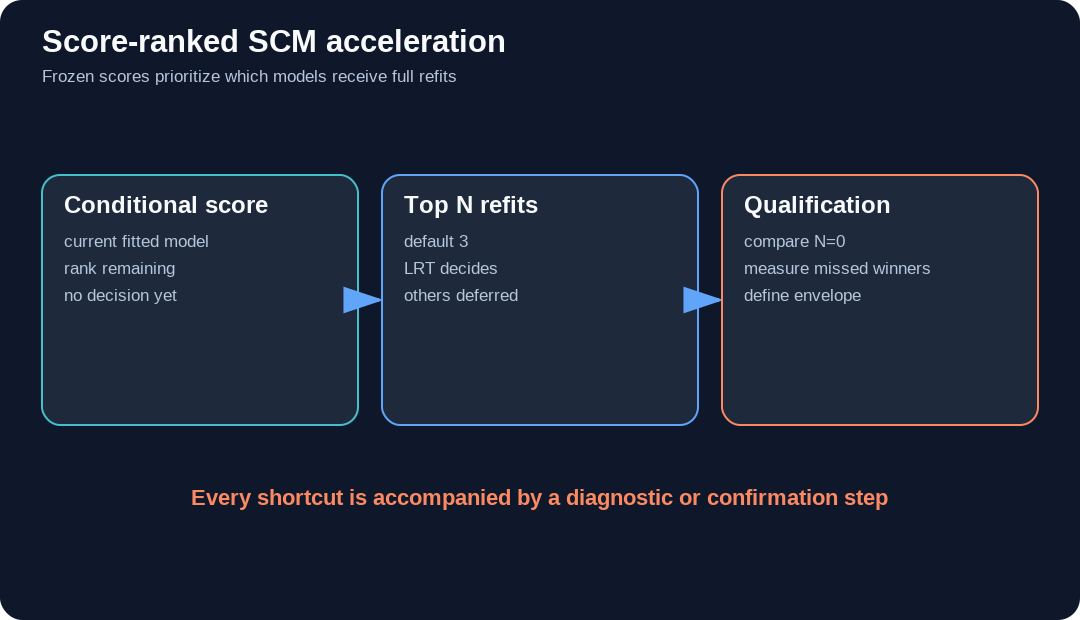
Before expensive forward refits, nlmx computes conditional frozen-model evidence to prioritize candidates. The ranking is local to the current fit and can be very effective when score and refit ordering agree. The final add/stop decision still comes from the candidate's optimized likelihood-ratio test.
Accuracy must be described empirically. Measure candidate-rank concordance, frequency of endpoint disagreement, coefficient differences, failed-refit behavior, runtime, and the kinds of designs where the cap is unsafe. Include high correlation, sparse categories, nonlinear forms, weak effects, parameter boundaries, and poor base stationarity. A single easy example is a demonstration, not a qualification.
When the cap excludes a candidate, the trace should be read as “not refitted at this step,” never “nonsignificant.” The candidate can be reconsidered on a later active model if it enters the top N, but there is no guarantee. Use N=0 as the direct sensitivity whenever selection accuracy dominates runtime.
Common mistakes
- Treating a stepwise p-value as clinical importance or causal proof.
- Reading a candidate comparison without its active model, convergence state, degrees of freedom, and exact threshold.
- Reporting only the terminal relationship list while discarding failed models, path decisions, configuration, and provenance.
Page checklist
- The scientific question, model identities, and comparison direction are explicit.
- Numerical validity is reviewed before interpreting statistical evidence.
- The result is linked to the complete trace and final joint-model diagnostics.