34.12 Settings files and exact rerunability
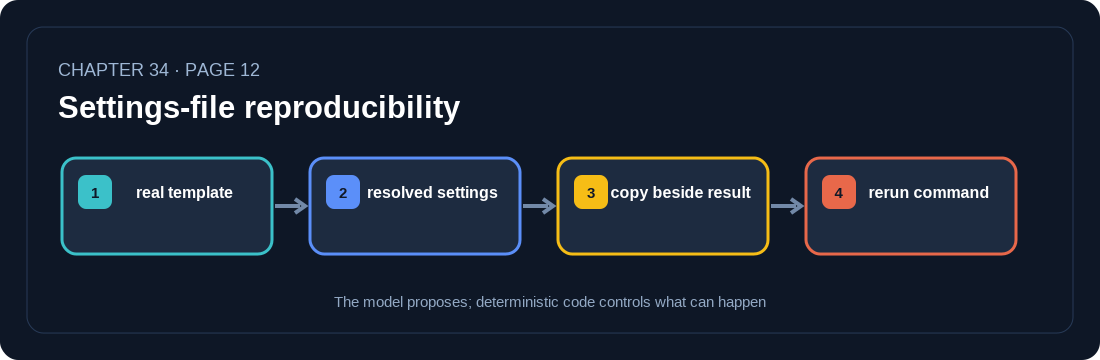
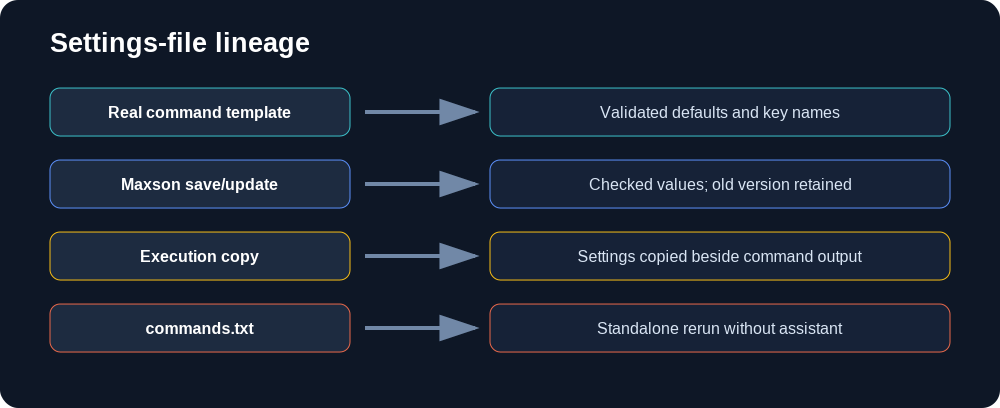
With settings_files=true, commands that have templates run with a saved settings file. Maxson may fill a real template through save; if none is supplied, nlmx writes the command’s default template and adds -c. Values and key names are validated before use.
How the mechanism works
Current template-capable commands include qc-data, qc-nm, eda, custom, report, nca, autoinit, screen, vpc, forest, sims, generate, ask, er, and power. Cov/posterior/inspect/validate require a covariate configuration. Fit has no settings file, so nlmx writes every estimation option explicitly and saves fit_command.txt.
Evidence from nlmx 4.16.1
The allowed demonstration produced 01_qc-data.qcd and copied it into 01_qc-data/. commands.txt contains the exact standalone command with -c; the step has its console log and checksum manifest.
Executed evidence: txtExecuted standalone commands.
What the mechanism protects—and what it does not
The mechanism controls a defined part of the workflow. It does not make the model’s prose correct, select the right scientific question, validate external data, or transfer accountability away from the user. Treat policy safety, computational success, statistical adequacy, and scientific validity as separate conclusions.
Review practice
A rerunnable command reproduces declared computation, not necessarily an unchanged environment. Preserve executable/version/hash, source input hashes, platform, dependencies, random seeds, and external reference software. Corrections create settings history so the final file does not erase earlier decisions.
For a novice, read the human transcript first, then the JSONL event log, exact settings/commands, and native command outputs. “The session completed” describes the outer process only; individual proposals may have been planned, declined, refused, failed, corrected, or executed.
Evidence to retain
- nlmx version/build, backend identity,
.asksettings, policy, limits, and system prompt; - request, raw replies, help/manual/file context events, confirmations, refusals, and corrections;
- every settings version and exact executed command, with child exit status and full output;
- reviewer interpretation, unresolved warnings, scientific limitations, and final disposition.
Navigation
See the previous page, next page, and guardrail, policy, and audit index.