Parameter and covariate filters
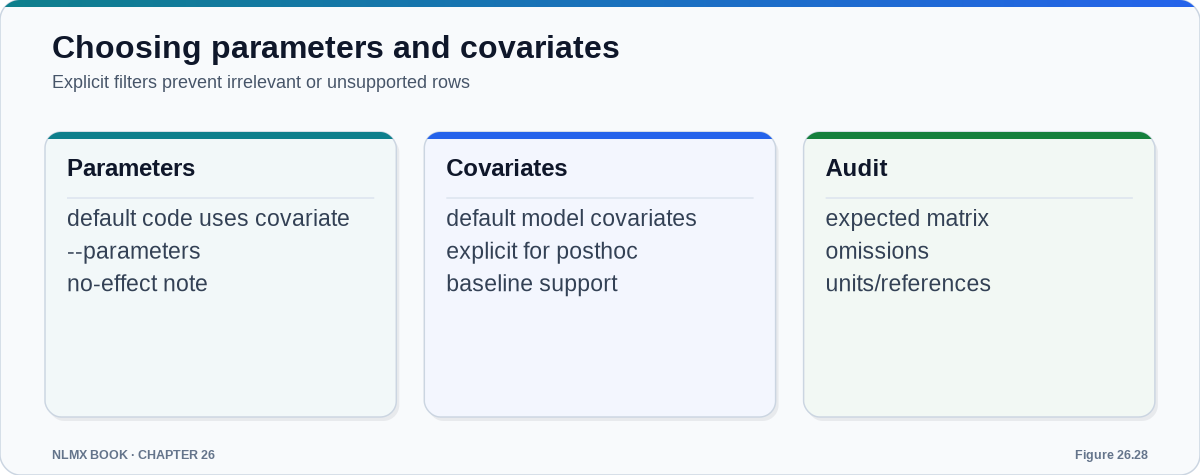
--parameters CL,V limits parameter sections. By default nlmx uses parameters whose code changes with covariates. --forest-covariates limits model-effect rows and explicitly names subgroup covariates for post hoc exposure, including covariates not present in parameter code.
Define the expected parameter–covariate matrix before execution. Review console notes for omitted no-effect combinations and confirm parameter names match code variables. A requested fixed or derived parameter may not be recognized if its assignment cannot be evaluated as intended.
Filters change the communication scope, not the fitted model. Preserve a complete sensitivity or source table when a publication figure shows only selected rows, and document why rows were excluded.
Common mistakes
- Treating a forest ratio or reference-band class as covariate-selection evidence, causality, or an automatic dosing recommendation.
- Omitting the reference subject, uncertainty source, regimen, subgroup denominator, data support, or fitted-model diagnostics.
- Confusing parameter-uncertainty intervals, BSV ranges, and subject-bootstrap intervals because they share one graphic.
Page checklist
- The numerator, denominator, fitted model, covariate settings, and units are explicit.
- The interval source and clinical meaning are distinguished from BSV and selection uncertainty.
- Tables, resolved settings, commands, diagnostics, limitations, and confirmation evidence are retained.