7.15 Settings-used files and rerun records
A settings-used file serialises the effective command configuration after defaults, file values and CLI overrides have been applied. For the power command, nlmx writes power_settings_used.power.
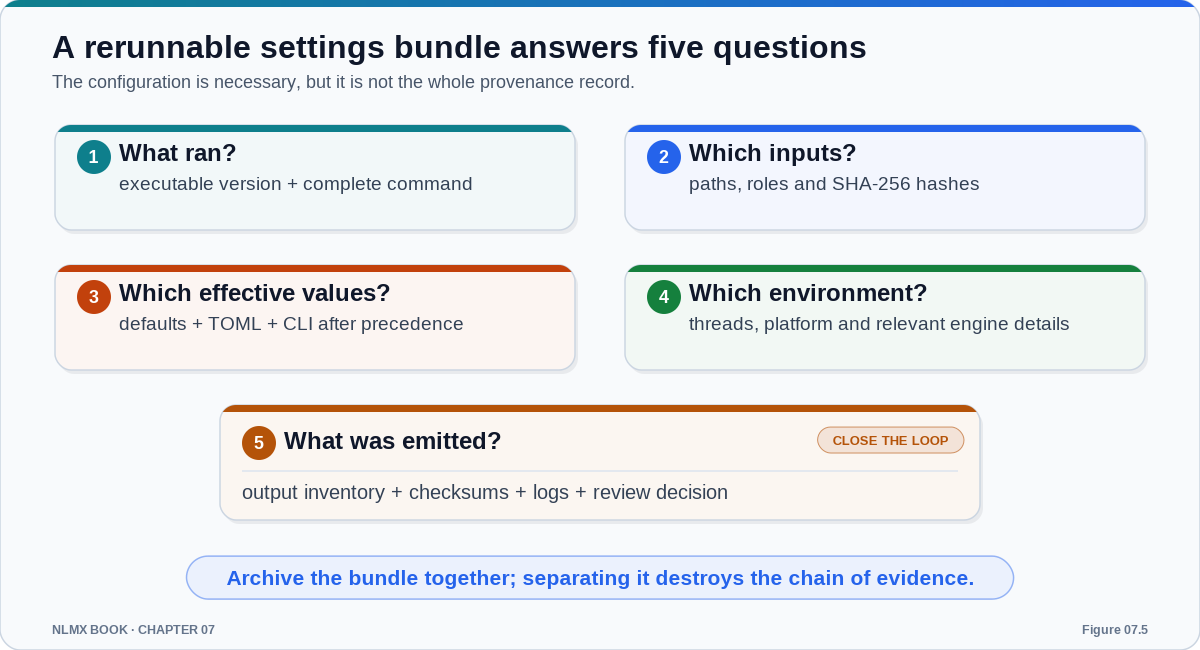
Figure 7.5. A settings file answers only part of the rerun question. Executable identity, input hashes, effective values, environment and output integrity close the provenance chain.
The file is more complete than a compact source configuration. It can contain defaulted [estimation], [sse], [criteria] or other sections even when the selected method is FIM. These values document the effective configuration structure; inactive method sections did not necessarily affect the executed engine.
What to retain
A defensible rerun bundle contains:
- source settings file and its digest;
- settings-used file;
- exact command and working directory;
- nlmx version and, for formal validation, executable digest;
- all model/data inputs or stable references plus hashes;
- input manifest, complete log and output checksums;
- result tables and any required figures/reports;
- platform and thread information when numerically relevant.
No single artifact replaces the others. The source settings captures reviewed intent. The settings-used file captures merged values. The command explains overrides and path origins. The manifest binds inputs. The log records execution.
Rerun versus reproduction
A rerun uses the same software and inputs. A reproduction may intentionally use a different environment or independent implementation. Label these separately. Matching settings text across programs does not prove matching algorithms or numerical conventions.
For random workflows, preserve seeds and stream-allocation rules. A seed alone may not recreate results after changing thread count, algorithm, platform or software version. Chapter 9 will establish those numerical boundaries.
Comparing effective files
Parse TOML and compare values rather than line formatting. Array layout, quote style and key order can differ without changing meaning. Categorise differences as scientific, numerical, operational or presentation-only; review scientific and numerical differences before judging output agreement.
Common mistakes
- Treating the source file as proof that no CLI override occurred.
- Treating inactive default sections as executed methods.
- Comparing TOML only as raw text.
Checklist
- Archive both source and settings-used files.
- Preserve invocation, binary identity and hashes.
- Classify every effective-value difference before comparison.
Further reading
See input manifests, output evidence and configuration review.