18.17 Conditional-mode search
Conditional methods repeatedly minimize \(J_i(\eta)\). nlmx uses damped Gauss–Newton curvature, a symmetric-rank-one correction, and a trust region limited to three OMEGA SDs per coordinate. ETA gradients are exact forward-mode automatic derivatives.
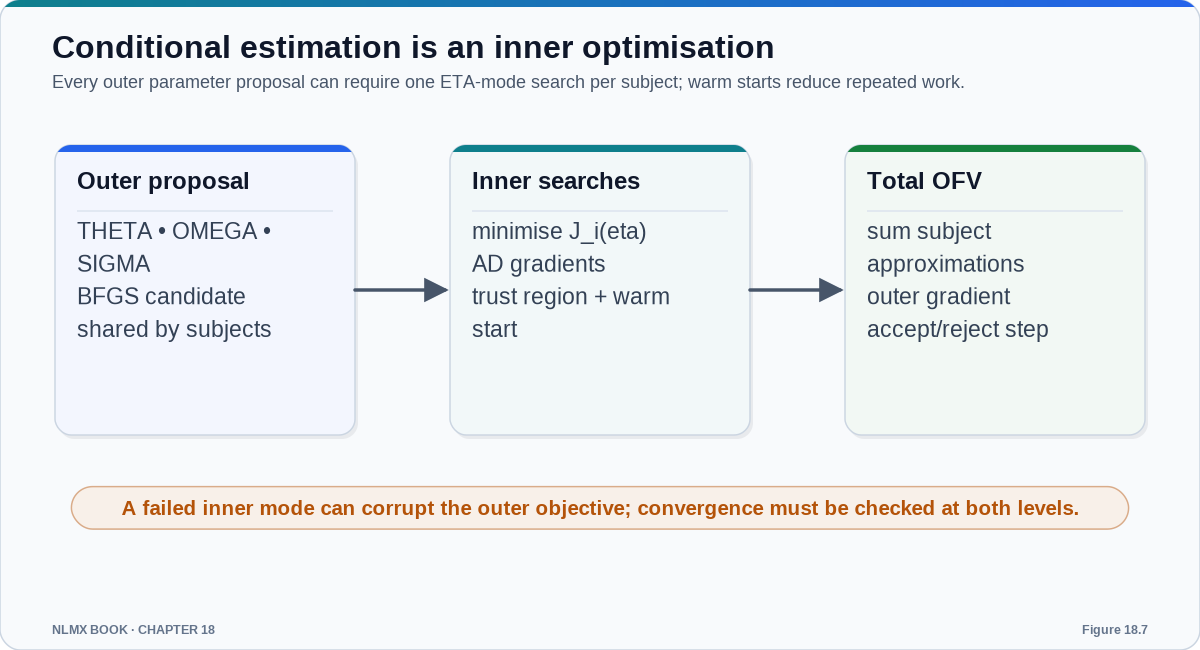
The mode begins from the previous outer iteration’s ETA. If that warm search fails, nlmx retries from zero and keeps a converged or lower-objective solution. Candidate steps use Newton and scaled steepest directions with backtracking. This protects against large invalid moves without guaranteeing a global mode.
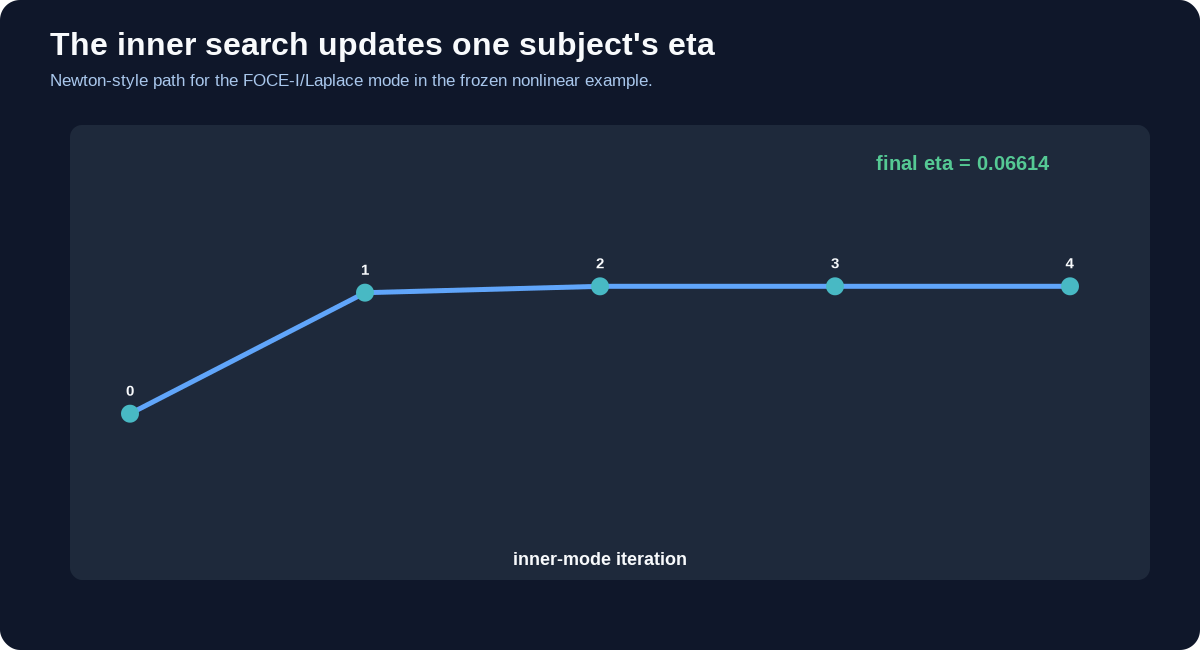
Inner convergence tolerance and maximum iterations affect outer smoothness. If one subject switches modes abruptly, finite-difference population gradients can become noisy. Report subject failures rather than silently accepting incomplete modes.
Practical interpretation
The Chapter 18 mode-path CSV records ETA, objective, gradient and curvature by iteration. Replot it on both ETA and objective axes. Then start the same search at several points. Convergence to one location supports—but does not prove—a unique mode. Different endpoints reveal conditional multimodality or numerical difficulty that the outer optimizer may otherwise obscure.
In higher dimensions, inspect the worst subjects by iteration count and final gradient. They often reveal data errors or structural ambiguity sooner than the total OFV trace.
Archive those subject-level diagnostics with the fit so a later reviewer can distinguish isolated difficulty from population-wide instability.
Common mistakes
Do not assume warm starts always improve the solution, ignore a few failed subjects, or confuse the inner Hessian with the population covariance-step Hessian.
Checklist
- Record inner failures and iteration burden.
- Retry suspicious subjects from alternative starts.
- Inspect conditional objective profiles when feasible.
- Keep tolerances stable across comparisons.
- Diagnose abrupt mode switching.
Further reading
Open the computed csvmode path CSV and read AD versus finite differences.