22.6 Base-model readiness for covariate analysis
Covariate selection assumes the base model is an acceptable reference. A covariate can compensate for structural, event, residual-error, or data problems, producing a statistically attractive but scientifically misleading term.
Before cov, verify input identity, estimation method, convergence, gradient, covariance status, parameter plausibility, boundaries, condition number, shrinkage, residual patterns, study/endpoint strata, and influential subjects. Review the intended population and missing-data policy.
Required artifacts depend on method. The control stream and final .ext define the model and base estimates. The dataset provides covariates and likelihood records. .cov/.cor support parameter uncertainty and reconciliation. .phi supplies individual estimates/posterior covariance for posterior workflows; a table may provide ETA columns when PHI is unavailable, subject to method limitations.
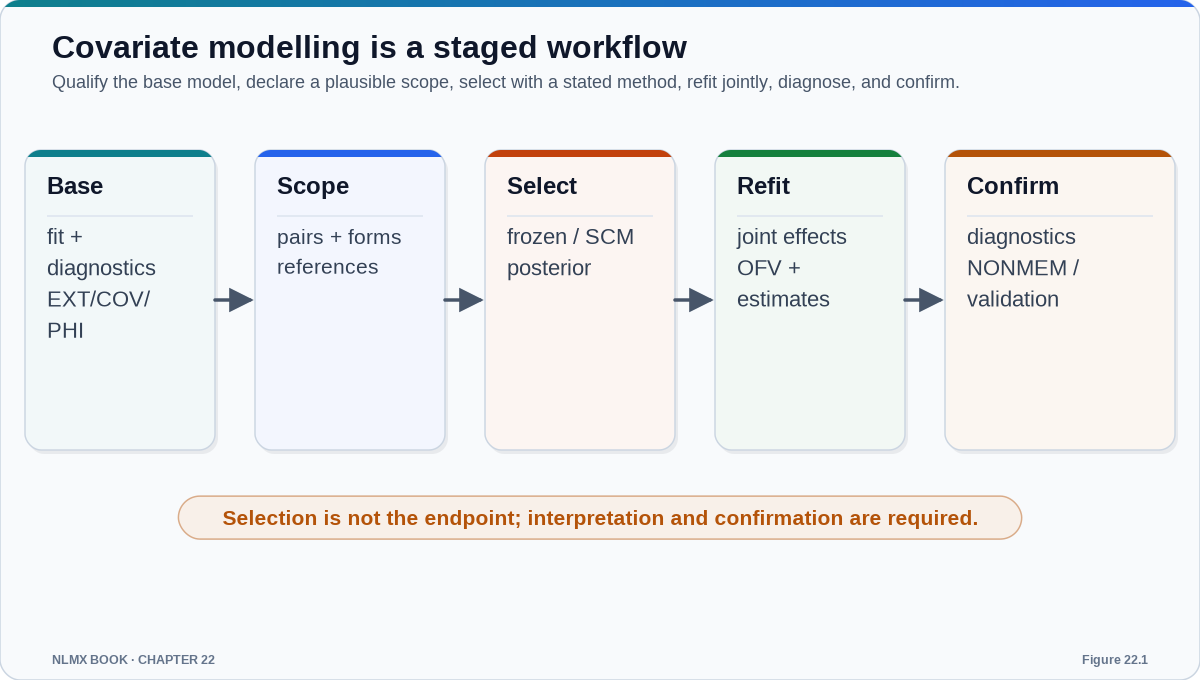
A boundary or ill-conditioned covariance can block uncertainty propagation even when minimization converged. The Chapter 22 example deliberately uses a proportional-only residual model after a combined-error base fit produced a near-zero additive component and unusable covariance conditioning. Simplifying was justified by the data-generating model and diagnostic evidence, not merely to make cov run.
Record the base-model version and freeze it during a planned selection comparison. Changing the base fit between frozen, SCM, and posterior runs confounds method differences.
A go/no-go decision
Proceed only when the base model is scientifically defensible and numerically stable enough that candidate evidence is not dominated by unresolved structural problems. Record convergence status, parameter plausibility, boundary estimates, covariance quality, condition number, shrinkage, residual diagnostics, influential subjects, and sensitivity to initial estimates. Covariate analysis can reduce unexplained variability, but it should not be used to repair a wrong compartment structure, absorption model, residual-error model, or endpoint mapping. If a defect is likely to alter EBEs, scores, or likelihood comparisons, fix and refit the base model first. Freeze the accepted base artifacts and their checksums so every engine starts from the same evidence.
Common mistakes
- Running selection on a nonconverged base model.
- Allowing covariates to mask structural misspecification.
- Ignoring covariance conditioning required by uncertainty calculations.
- Comparing methods from different base solutions.
- Treating artifact presence as proof of compatibility.
Checklist
- Confirm convergence, covariance, boundaries, and diagnostics.
- Reconcile control, EXT, COV/COR, PHI, and data identities.
- Resolve material structural or error-model findings first.
- Freeze one documented base model for comparisons.
- Preserve checksums and method/version information.
Further reading
See Chapter 21’s complete diagnostic checklist, input discovery, and validation.