22.8 Declaring scope on the command line and in configuration
Scope is the set of parameter–covariate relationships the analysis is allowed to consider. A relationship outside scope is not a rejected hypothesis; it was never tested.
The simple configuration form is readable and versionable:
[input]
model_dir = "fits/run101"
run_stem = "run101"

[covariates]
CL = ["WT", "EGFR", "SEX"]
V  = ["WT", "SEX"]
The same scope can be passed without a file:
nlmx cov --ctl run101.ctl `
  --covariates "CL=WT,EGFR,SEX;V=WT,SEX"
--covariates is repeatable, and a CLI scope replaces the configuration scope. Parameter names come from assignments in $PK or $PRED; covariate names follow $INPUT and are case-insensitive. Verify aliases and dropped columns.
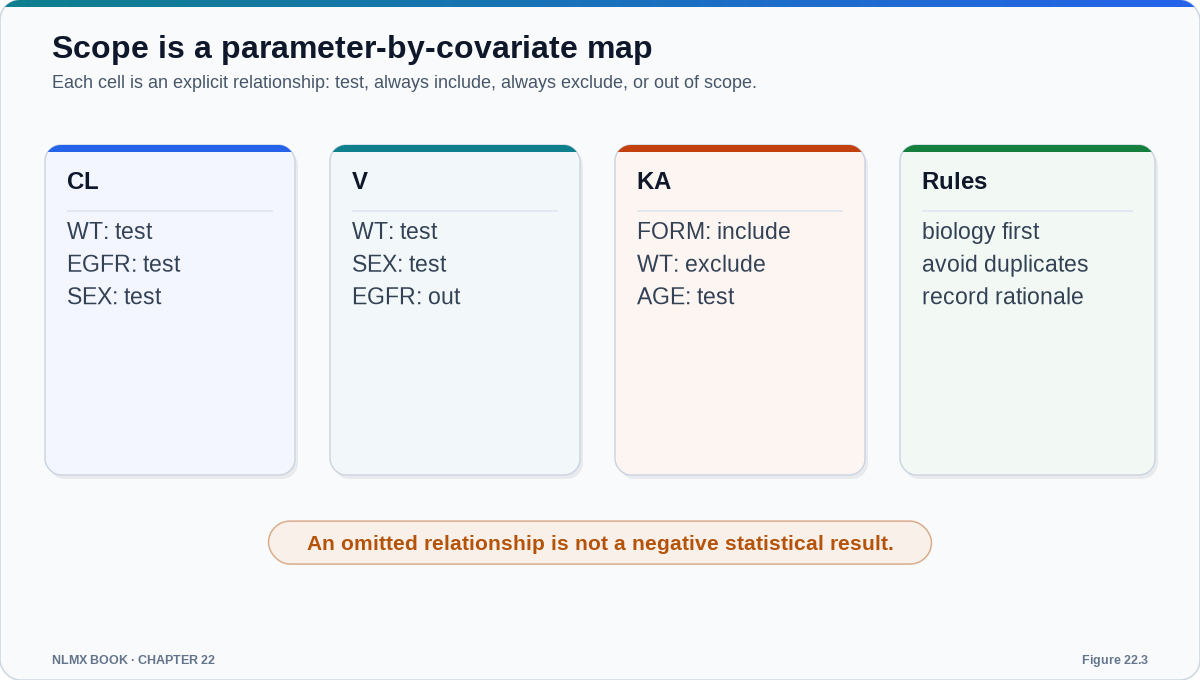
The detailed configuration form supports per-covariate positivity, range, time-varying status, levels, minimum level subjects, and relationship status. Use it when simple lists cannot express the analysis plan. Do not mix simple and detailed forms ambiguously.
Limit scope scientifically. Testing every measured covariate on every parameter inflates multiplicity, computation, instability, and interpretive burden. Include plausible mechanisms and required confounders; explicitly exclude impossible or redundant pairs with rationale.
A practical scope review
Read the declared scope row by row as a set of scientific hypotheses. For each PARAM~COV pair, write down the mechanism, expected direction, plausible magnitude, permitted form, and whether the relationship is mandatory, testable, or prohibited. Then compare the list with the actual data: a clinically attractive hypothesis is not estimable when nearly every subject occupies the same level or when the informative range is absent. A large search space also changes the interpretation of marginal p-values and stability frequencies. Preserve the original scope before selection; quietly adding candidates after seeing results converts a prospective search into an exploratory one and should be labeled accordingly.
Common mistakes
- Calling out-of-scope relationships “not significant.”
- Passing CLI scope unintentionally over a configuration scope.
- Using dataset headers that do not match
$INPUTmeaning. - Testing an exhaustive Cartesian product without rationale.
- Failing to version the final resolved scope.
Checklist
- Create a parameter-by-covariate scope table.
- Record scientific rationale for inclusion/exclusion.
- Confirm names, aliases, and availability.
- Choose simple or detailed configuration deliberately.
- Inspect the normalized resolved scope before running.
Further reading
See scope status, multiplicity, and inspection commands.