41.15 Case 4: does the block OMEGA earn its extra parameter?
What you will learn
- Compare a diagonal and a block OMEGA with a likelihood-ratio test, AIC and BIC.
- Convert a covariance into a correlation and read it.
- Handle a borderline result: say what the criteria say, and what they cannot.
- Know when a shared covariate may explain a correlation.
Prerequisites: 41.13 and Chapter 20, OMEGA blocks.
The question: are the between-subject random effects on clearance and volume correlated, and is it worth modelling?
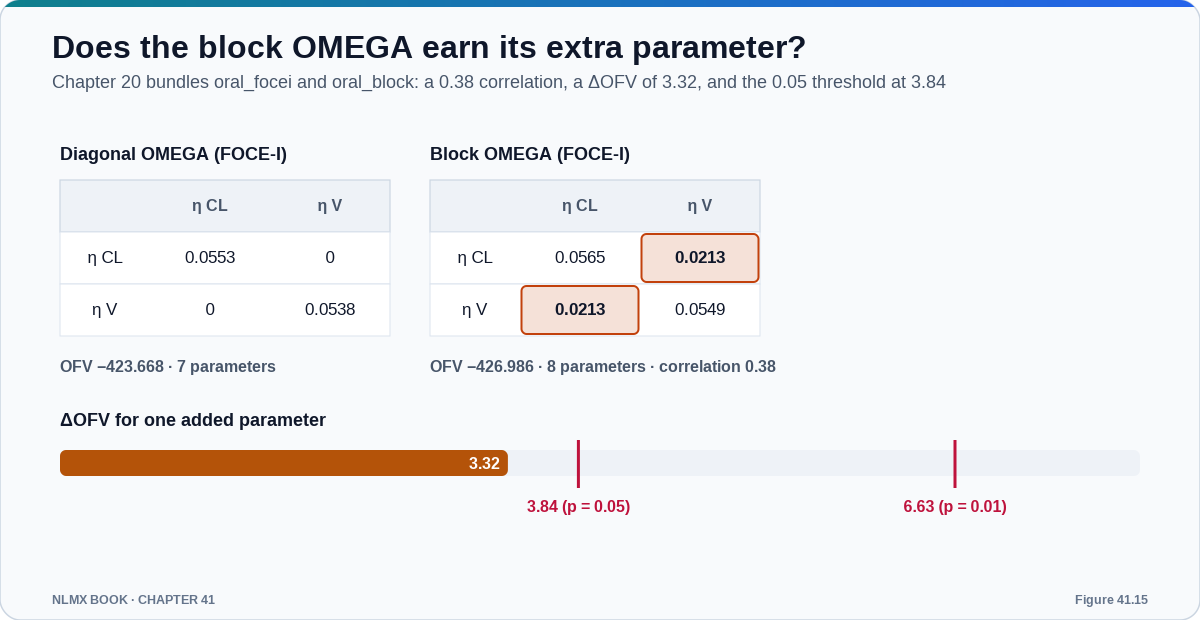
The evidence: two Chapter 20 bundles fitted with FOCE-I on the same data: oral_focei (diagonal OMEGA) and oral_block ($OMEGA BLOCK(2), input run20_block.ctl).
What a block does
A diagonal OMEGA says that the random effect on CL and the random effect on V are independent: a subject with a high clearance is no more likely than any other to have a large volume. A block adds the off-diagonal covariance, one extra parameter, so that the two can move together.
| Diagonal | Block | |
|---|---|---|
| ω²(CL) | 0.05526 | 0.05646 |
| ω²(V) | 0.05382 | 0.05489 |
| ω(CL, V) | 0 | 0.02132 |
| Parameters | 7 | 8 |
| OFV | −423.668 | −426.986 |
| Iterations | 17 | 20 (340 evaluations) |
The covariance is on the scale of the variances, so it is read as a correlation: 0.02132 / √(0.05646 × 0.05489) = 0.383, which the program prints as 0.383037 corr. A positive correlation of 0.38 says that subjects who clear the drug faster tend also to have a larger volume, as when both scale with body size.
Three criteria, three answers
The block lowers the OFV by 3.318 for one extra parameter. Three standard criteria turn this into a decision:
| Criterion | Rule | Value | Preferred |
|---|---|---|---|
| Likelihood-ratio test | ΔOFV > 3.84 (p < 0.05, 1 df) | 3.318, p = 0.069 | diagonal |
| AIC | ΔOFV − 2 per added parameter | 3.318 − 2 = +1.32 in favour of the block | block (slightly) |
| BIC, penalty ln(24) per random-effect parameter | ΔOFV − ln(24) | 3.318 − 3.178 = +0.14 for the block | tie |
| BIC, penalty ln(192) (all observations) | ΔOFV − ln(192) | 3.318 − 5.257 = −1.94 | diagonal |
(Each line is computed from the two OFVs above; the choice of penalty is a property of the criterion, not of the program.)
So: the likelihood-ratio test at 5 % says diagonal; AIC says block, by a margin too small to matter; the BIC says either, depending on which sample size is taken to be n. When four reasonable criteria split two and two, the data do not decide the question. The result is borderline, and the right report says so.
What would settle it
- A covariate. The data file carries body weight (
WT) and aGROUPcolumn. A correlation between CL and V in a population is often just the footprint of one shared covariate: weight raises both. Adding weight to both parameters (Chapter 22) frequently removes the correlation, and with it the question. Test the covariate first; a block is a way to model what you have not yet explained. - The standard error of the correlation. The block fit reports no standard errors (the covariance step was not run for this bundle), so the uncertainty of 0.383 is unknown. A correlation of 0.38 with 24 subjects has a wide interval. With the covariance step, the block's confidence interval is the better evidence than any OFV difference.
- What the correlation is for. If the model will be used for simulation, ignoring a real correlation of 0.38 would give simulated individuals with the wrong joint distribution of CL and V, which changes the simulated variability of AUC (for an oral dose, AUC depends on CL alone, but Cmax depends on both). If the model is only for covariate screening, the question matters less.
The other estimates barely change
Moving from diagonal to block, CL changes from 3.838 to 3.846 (+0.2 %), V from 42.62 to 42.50 (−0.3 %), KA from 1.132 to 1.127 (−0.4 %), and the proportional SD from 0.1507 to 0.1503. The fixed effects are insensitive to the choice, as is common: the decision about OMEGA structure is mostly a decision about variability and simulation, not about typical values.
The decision
| Question | Evidence | Decision | Reversible? |
|---|---|---|---|
| Keep the block? | LRT p = 0.069; AIC +1.3 for block; BIC tie; correlation 0.38 with no SE | Keep the diagonal OMEGA for now; carry the block as a sensitivity run; revisit after testing weight on CL and V | yes |
What would change it: a covariance step on the block fit showing a confidence interval for the correlation that excludes zero; or loss of the correlation after the weight effect enters, which would remove the need for a block altogether.
What this case does not show
It does not show the covariance step on the block, nor the covariate refit: neither is in a frozen bundle. It shows only how a borderline structural choice is stated honestly.
Review checklist
- Did you compute the correlation, not only the covariance?
- Did you say which penalty your BIC uses?
- Is the result reported as borderline when the criteria split?
- Have you tested a shared covariate before spending a parameter on the correlation?
Navigation
See the previous page, the next page and the complete case-study reference.