17.28 Reproducibility, parallelism, runtime, and checksums
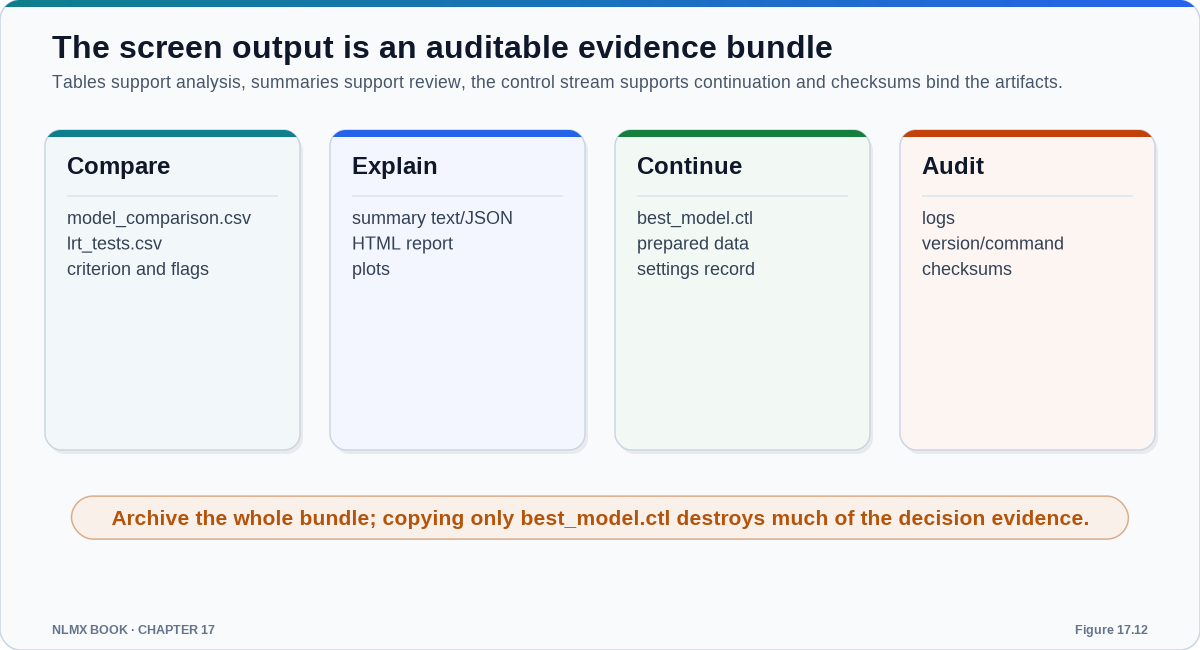
A reproducible screen identifies the nlmx build, operating system/architecture, exact command, resolved settings, input checksum, candidate list, thread count, seeds, output checksums and relevant hardware. Archive these before editing downstream control streams.
Parallel candidate scheduling reduces elapsed time because independent fits can run concurrently. --serial-models is valuable for debugging and resource-constrained systems. --threads limits worker capacity. Deterministic methods should produce equivalent scientific results under different scheduling; stochastic autoinit/SAEM must use named streams or documented seeds to make thread order irrelevant.
Runtime is not just SECONDS summed across rows: wall time depends on parallel overlap, initialization, plotting, covariance and I/O. Performance claims must state whether candidate-fit outputs and reports were enabled. Compare warm/cold cache and repeated runs when benchmarking against major pharmacometrics software.
Checksums detect byte changes, not scientific equivalence. Text line endings or nondeterministic metadata can change a checksum without changing estimates; conversely, matching summaries do not prove all underlying artifacts match. Use numeric tolerance tests plus file-integrity hashes.
For performance reproduction, run enough repetitions to estimate variability and separate initialization, fit, covariance and reporting time. Report median and spread rather than the fastest run. When comparing with another software package, align compiler optimization, CPU allocation and numerical accuracy; otherwise a speed ratio has little scientific meaning.
Common mistakes
Do not call a run reproducible with only a seed, benchmark debug builds, compare different candidate sets, or ignore thread oversubscription. Avoid regenerating checksums after an unexplained change and treating the new list as proof.
Checklist
- Capture version, command, resolved config and environment.
- Freeze inputs and candidate names.
- Record seeds, streams and thread settings.
- Separate wall-time benchmarking from numerical validation.
- Verify hashes and numeric tolerances independently.
Further reading
See validation boundaries and the planned Chapter 42 validation framework.