Steady-state exposure sections: overview
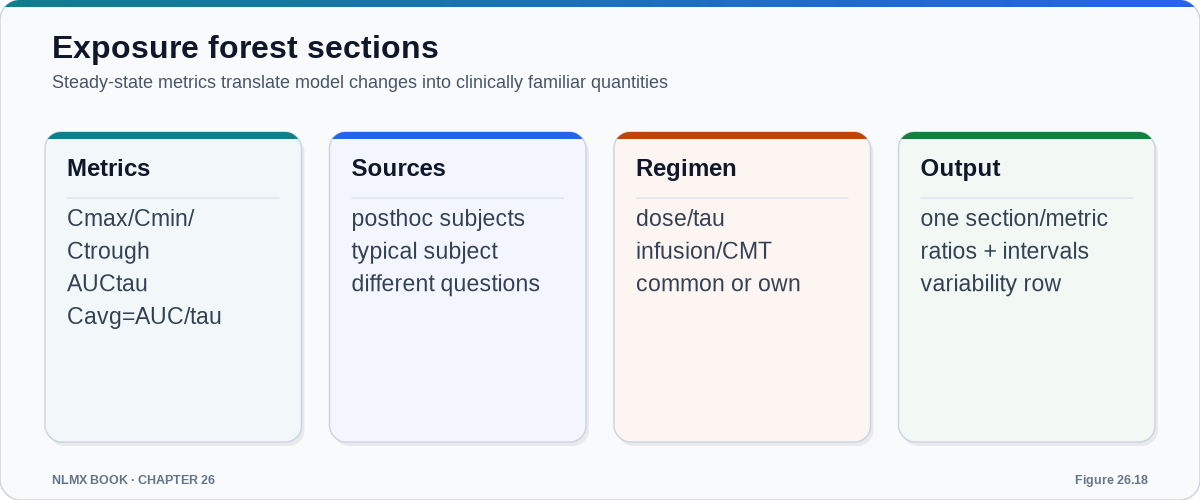
--exposure accepts cmax, cmin, ctrough, auc, cavg, or all. Each metric becomes its own forest section. --exposure-only removes parameter rows when the communication objective is purely exposure.
Two sources answer different questions. posthoc (default) simulates each subject using individual ETAs and compares covariate subgroups. typical simulates ETA=0 subjects at parameter-row covariate values and scenarios while propagating parameter uncertainty. Do not describe them with interchangeable wording.
Every result is conditional on the steady-state regimen and model. Report dose, interval, infusion duration, compartment, source, reference, bins, grid, CI, and whether PHI or reconstructed modes supplied individual parameters.
Common mistakes
- Treating a forest ratio or reference-band class as covariate-selection evidence, causality, or an automatic dosing recommendation.
- Omitting the reference subject, uncertainty source, regimen, subgroup denominator, data support, or fitted-model diagnostics.
- Confusing parameter-uncertainty intervals, BSV ranges, and subject-bootstrap intervals because they share one graphic.
Page checklist
- The numerator, denominator, fitted model, covariate settings, and units are explicit.
- The interval source and clinical meaning are distinguished from BSV and selection uncertainty.
- Tables, resolved settings, commands, diagnostics, limitations, and confirmation evidence are retained.