Purpose, questions, and accuracy boundary
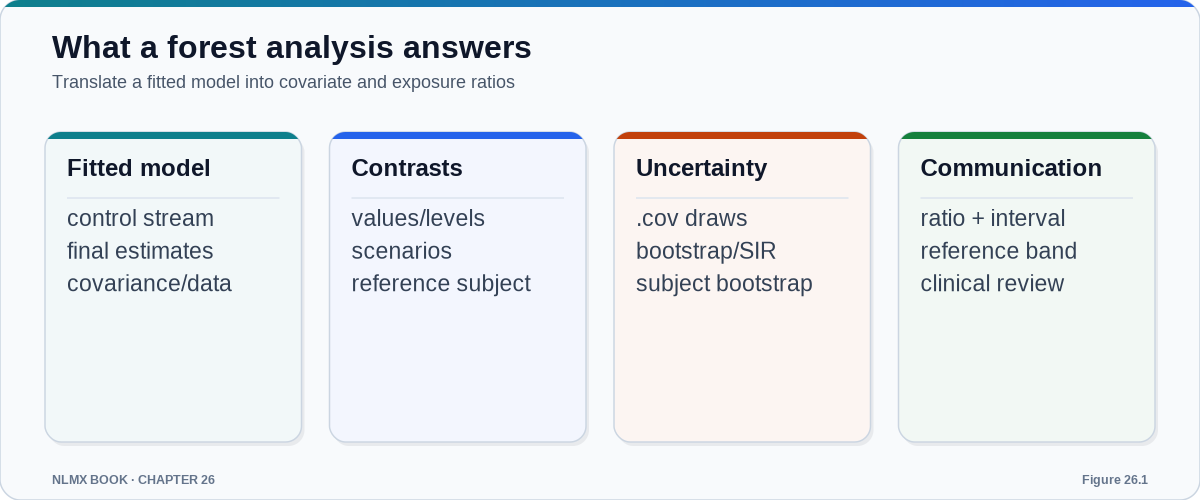
A pharmacometric forest plot translates a fitted model into ratios that can be reviewed clinically. For each parameter, exposure metric, covariate setting, or multi-covariate scenario, nlmx forest compares the model value with a declared reference. It can add parameter-uncertainty intervals, between-subject variability context, and a prespecified reference band.
The command answers communication questions—how CL changes at low WT, how AUC changes in renal impairment, or how exposure differs between post hoc subgroups. It does not select covariates, refit the model, establish causality, or choose a dosing adjustment. Every row inherits the fitted model, its uncertainty, the selected covariate equations, the data support, and the regimen assumptions.
Accuracy therefore has two layers. The numerical layer requires correct model-code execution, estimates/covariance labels, parameter draws, individual ETAs, and steady-state simulation. The scientific layer requires meaningful contrasts, plausible scenarios, appropriate uncertainty, diagnostics, and clinical thresholds. A polished forest figure cannot repair an unvalidated final model.
Common mistakes
- Treating a forest ratio or reference-band class as covariate-selection evidence, causality, or an automatic dosing recommendation.
- Omitting the reference subject, uncertainty source, regimen, subgroup denominator, data support, or fitted-model diagnostics.
- Confusing parameter-uncertainty intervals, BSV ranges, and subject-bootstrap intervals because they share one graphic.
Page checklist
- The numerator, denominator, fitted model, covariate settings, and units are explicit.
- The interval source and clinical meaning are distinguished from BSV and selection uncertainty.
- Tables, resolved settings, commands, diagnostics, limitations, and confirmation evidence are retained.