31.22 Null replicates and empirical Type I error
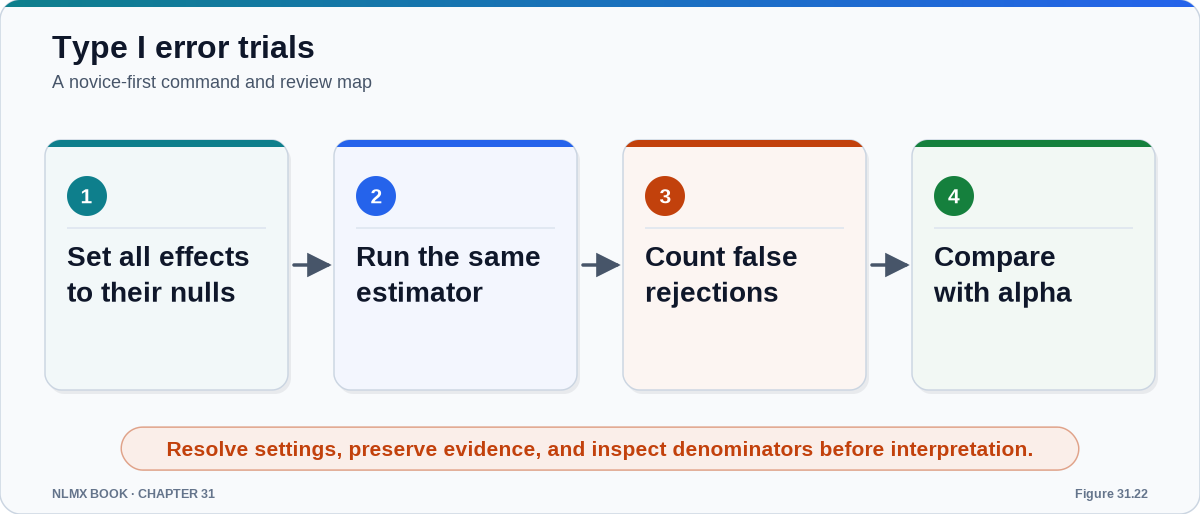
--type1-replicates N adds N trials per scenario with every declared effect at its null. The same design, estimator, and primary test are used. The reported false-rejection fraction should be judged with its own binomial uncertainty.
What the controls mean
- No hypotheses means no null trials are scheduled.
- Four null trials move only in increments of 0.25; an observed zero is not evidence of calibration.
- Median ΔOFV in the alternative rows is not a substitute for null calibration.
The issued command is only the beginning of the audit trail. Always distinguish the reference model, the design template, the resolved scenario, the replicate-specific truth, the fitted result, and the test decision. A value can be correct at one layer and misinterpreted at another.
Command or settings pattern
--type1-replicates 500
Command-line values override settings-file values. Use a fresh folder for an analytical run; preserve the command, resolved settings, log, checksums, and row-level data. Defaults are versioned behavior, so a production protocol should state important values explicitly.
Interpretation and quality control
Prespecify an acceptable interval around alpha and use enough null trials to evaluate it.
For a novice review, first confirm counts and labels, then inspect numerical values, then ask whether the assumptions represent the proposed clinical study. For an expert review, additionally reconcile aggregates from row-level output, reproduce a subset of trials, and compare the implementation with an independent reference where the claim requires it.
Common mistakes
- Calling zero of four proof of Type I control
- Using easier starts or settings for null trials
- Reporting a point estimate without its denominator, interval, method, and version
Minimum evidence to retain
- nlmx version, command,
.powerfile, resolved settings, seed, threads, and output checksums; - control stream, design dataset, EXT/COV or parameter sets, and their provenance;
- scenario table, replicate rows and failures, method summaries, plots, report, and interpretation;
- prespecified criteria, Monte Carlo target, validation scope, deviations, and reviewer decisions.
Navigation
See the previous page, next page, and complete command and settings index.