40.1 How to read a cross-software comparison
What you will learn
- Define the question before comparing products
- Use qualified status words instead of yes/no
- Separate capability evidence from validation evidence
Prerequisites: Chapter 39 troubleshooting, Chapter 36 command reference, and Chapter 38 output reference.
This page is scoped to nlmx 4.16.2 and an external-documentation snapshot of 2026-11-10. Product names describe different system boundaries; a blank or “outside role” is not a quality ranking. Treat every migration as a new implementation until model semantics, analysis population, objective definition, numerical behavior, outputs, and decisions have been independently reconciled.
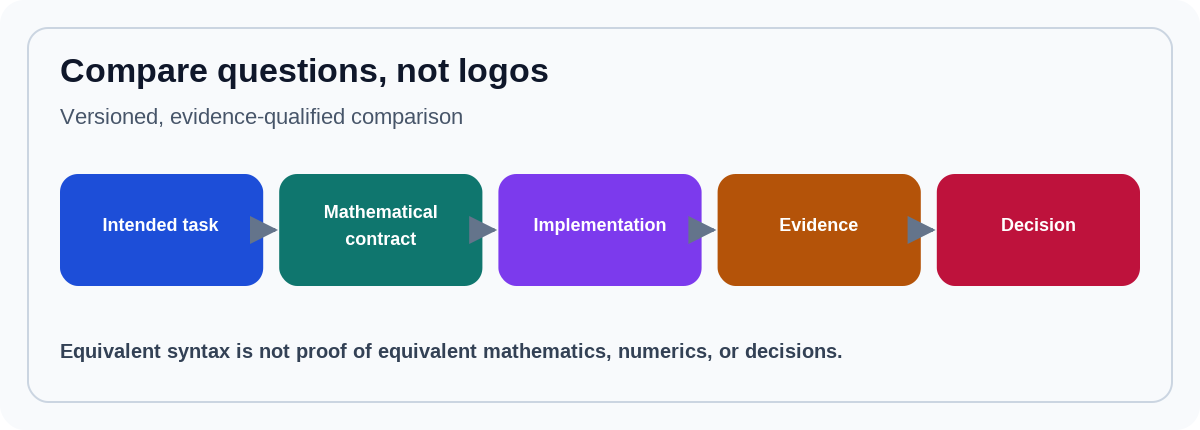
The wrong question is “Which package has feature X?” The useful question is “Can this version execute the same scientific task, with the same mathematical definition and acceptance evidence?” NONMEM, PsN, PopED, Monolix, and nlmx overlap, but their primary roles differ. NONMEM executes NLME estimation/simulation; PsN orchestrates NONMEM workflows; PopED evaluates and optimizes experimental designs, commonly through a FIM; Monolix integrates modeling tasks around SAEM; nlmx combines an independent estimator with QC, simulation, selection, reporting, and other workflows.
The tables use native, delegated, analogue, subset, refused/absent, and outside role. “Native” still does not prove identical algorithms. “Delegated” means the named product prepares or coordinates work executed by another engine. “Analogue” means similar purpose but different definition. “Subset” requires a boundary statement. “Refused” is safer than silent simplification. “Outside role” prevents penalizing PopED for not being a fit engine or NONMEM for not being a Markdown publisher.
For each comparison record product/version/build, license/configuration, platform, model/data, task, all method options, random seed/streams, thread/process layout, stopping criteria, outputs, and acceptance tolerances. Cite primary manuals and source. Never combine a current nlmx result with an undated recollection of another product.
Capability evidence answers “the function exists.” Validation evidence answers “this implementation gave acceptable results on this case.” Performance evidence answers “under this protocol, time/resource use differed.” Keep those conclusions separate.
A novice example
Suppose both nlmx and PopED print an “FIM.” That shared name is not enough. Ask whether one is an observed post-fit information matrix and the other an expected design matrix, which parameters are included, whether fixed/random-effect cross-blocks are zeroed, and whether residual variability is represented as a variance or standard deviation. Only after those questions are answered can two matrix elements or RSEs be compared. The same discipline applies to “SCM,” “SAEM,” “VPC,” and “OFV.”
Primary source note: Product roles are grounded in the ICON NONMEM page, official PsN repository, official PopED documentation, and Monolix documentation.
Review checklist
- Are the exact product versions, task boundaries, inputs, methods, and settings named?
- Were semantics and frozen-parameter results aligned before optimized outputs?
- Is the comparison using a method-appropriate deterministic or stochastic tolerance?
- Are unsupported or analogous features described without implying equivalence?
- Can every claim be reproduced from retained primary evidence?
Navigation
See the previous page, next page, and complete comparison reference.