Covariate, level, and parameter labels
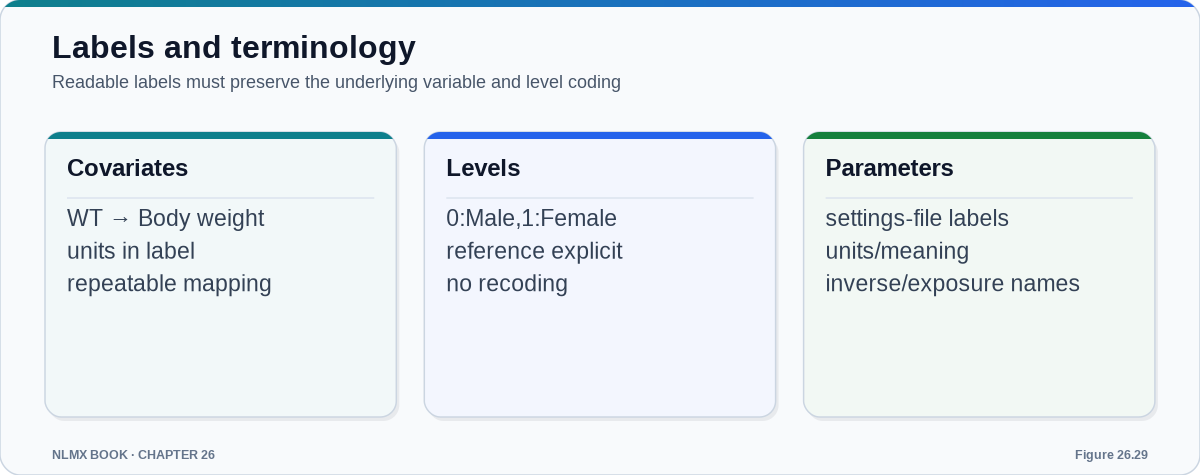
--covariate-labels COV=LABEL provides readable names and units. --level-labels maps coded values to labels. Parameter labels are available in the settings file. Labels should improve comprehension without hiding the source variable, coding, reference, or units.
Use consistent terminology across model report, forest table, and clinical documents. Avoid gender/sex mislabeling, ambiguous renal-function units, or unlabeled normalized variables. Preserve exact numeric settings in CSV/JSON even when plots use concise labels.
Review typography and line length at final output size. A label that fits an HTML viewer may overlap in a 7-inch publication PNG. Keep an accessible legend and define abbreviations in captions.
Common mistakes
- Treating a forest ratio or reference-band class as covariate-selection evidence, causality, or an automatic dosing recommendation.
- Omitting the reference subject, uncertainty source, regimen, subgroup denominator, data support, or fitted-model diagnostics.
- Confusing parameter-uncertainty intervals, BSV ranges, and subject-bootstrap intervals because they share one graphic.
Page checklist
- The numerator, denominator, fitted model, covariate settings, and units are explicit.
- The interval source and clinical meaning are distinguished from BSV and selection uncertainty.
- Tables, resolved settings, commands, diagnostics, limitations, and confirmation evidence are retained.