42.8 Installation qualification
What you will learn
- State what the eight installation tests establish and what they leave open.
- Record the executable's identity by SHA-256 and tie every later result to it.
- Interpret the two manual IQ tests and the supplier evidence on file.
- Fill in the environment table of the validation plan.
Prerequisites: 42.2 The lifecycle and Chapter 2 installing and upgrading.
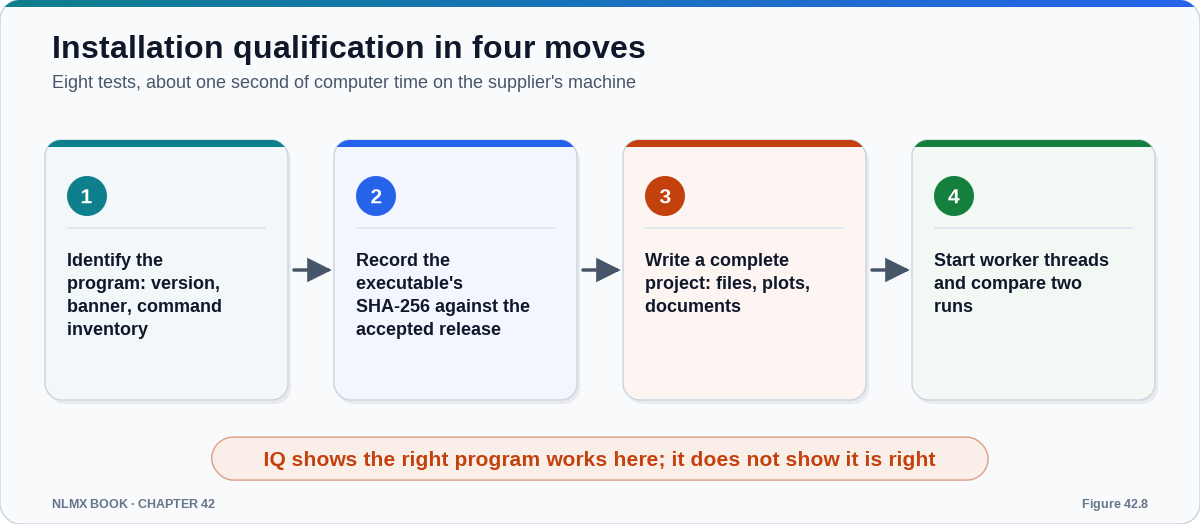
Installation qualification (IQ) answers a narrow question: is the right program installed here, intact, and able to do the basic things it must do on this computer? It does not ask whether the program is right; that is the job of operational qualification (page 42.9). IQ is quick—about one second of computer time on the supplier's machine—and it is the stage most often skipped when a program is copied to a new laptop. That is exactly when it matters.
The eight tests
| Test | What it checks | Risk | Notes |
|---|---|---|---|
| IQ-001 Identification | The version command and the first line of a log show the same version, with release date and licence text |
High | Ties the executable to the documented release |
| IQ-002 Command inventory | The global help lists every documented command | Medium | Catches an incomplete or mismatched build |
| IQ-003 Executable integrity (SHA-256) | The hash of the installed executable matches the released, accepted one | High | Manual: the reference hash comes from the supplier's release evidence |
| IQ-004 Licence | The licence text and version are displayed | Medium | |
| IQ-005 Write access and a complete project | The account can write files; the numerical core, the data-set writer and the estimator work end to end | Medium | Generates a project with data, control stream and a fitted base model |
| IQ-006 Graphics and document output | PNG, DOCX, PDF and HTML files are written on this platform | Low | Fonts and graphics libraries |
| IQ-007 Threads | Worker threads start and two runs give identical parameter tables | Low | A first look at determinism; DI-008 goes deeper |
| IQ-008 Package integrity and supplier evidence | The package manifest verifies as INTACT and the supplier documentation is on file | Medium | Manual: confirm the evidence is filed |
Two of the eight are manual because the reference for them lies outside the computer: only a human can confirm that the hash printed by IQ-003 is the hash the supplier published for this release, and that the supplier evidence is actually on file. Automating them would be circular.
Recording the executable's identity
Of all IQ outputs, one line matters most for the rest of the validated life of the installation: the SHA-256 of the executable. The validation plan's environment table asks for exactly this:
| Computer / OS | Executable version and SHA-256 | Tester | Date |
|---|---|---|---|
| (hostname, operating-system build) | (version string) · (64 hexadecimal characters) | (name) | (date) |
The validated state applies to exactly this executable on a computer of the same type. A different build, a different version or a different operating system needs at least a partial revalidation (page 42.17). Later, a periodic review confirms that no unreviewed change occurred by recomputing the hash and comparing it with the recorded one.
What a hash does and does not say
A SHA-256 changes completely if a single bit of the file changes (page 42.13 shows a computed example). It identifies the bytes you hold; it does not say the bytes are what the supplier intended unless you compare it with a hash obtained through an independent channel. That is why IQ-003 is a manual comparison against the supplier's release evidence, and why the evidence is kept with the record.
What IQ catches in practice
- A copy of the program from an older folder, picked up on the search path ahead of the validated one (IQ-001, IQ-003).
- An incomplete installation after an interrupted unpack (IQ-002).
- A locked-down account that cannot write to the working folder, or a server without the font files needed for PDF output (IQ-005, IQ-006).
- A container or virtual machine that exposes a single processing thread, where parallel-versus-serial determinism cannot be exercised (IQ-007).
Each of these would otherwise appear weeks later as a confusing failure in an analysis. IQ moves them to day one.
What IQ does not cover
IQ does not test the operating system, Python, the file system, the printer or the network. It confirms only that the program can write, plot and use threads where it is installed. It also says nothing about numerical accuracy; a program can pass every IQ test with a wrong objective function. For that you need the next page.
Executing IQ
python tools/nlmx_validate.py run --nlmx C:\path\to\nlmx.exe --tester "Your Name" --section 04_IQ --label iq
The run writes a folder under 10_results/; the two manual tests are listed as pending until you perform them against the protocol and record the result on the execution record (09_templates/execution_record.md), or run with --interactive. An IQ with pending tests is incomplete: the plan's acceptance criterion 1 is that every IQ test passes, and a pending manual test has not passed yet.
Review checklist
- Is the executable's SHA-256 on the execution record and in the environment table?
- Was the hash compared with an independently obtained reference?
- Are IQ-003 and IQ-008 signed by a named person, not left pending?
- Is the computer type the same as the one named in the validation plan?
Navigation
See the previous page, the next page and the complete validation reference.