35.1 Choosing and qualifying a language model
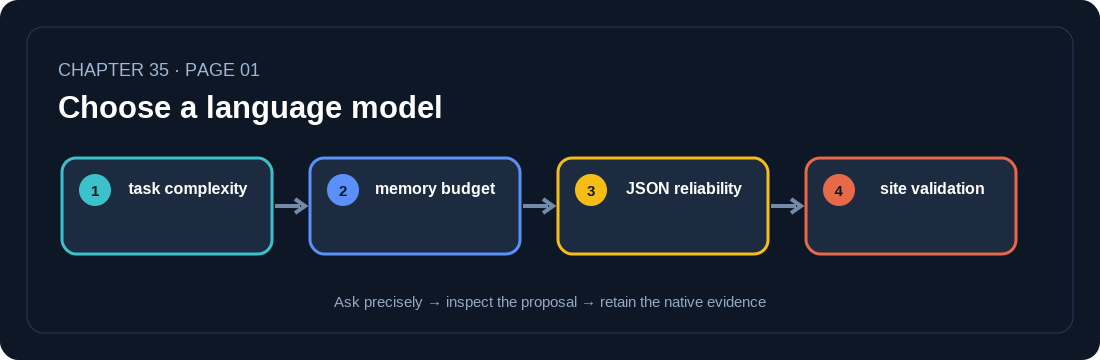
Maxson needs an instruction-tuned model that follows JSON structure, short tool protocols, and careful summarisation. The built-in guide recommends roughly 1.5–4B-parameter models for this narrow translator role, with Qwen2.5 3B Instruct as the documented balance. Model size alone does not establish suitability.
How to use it
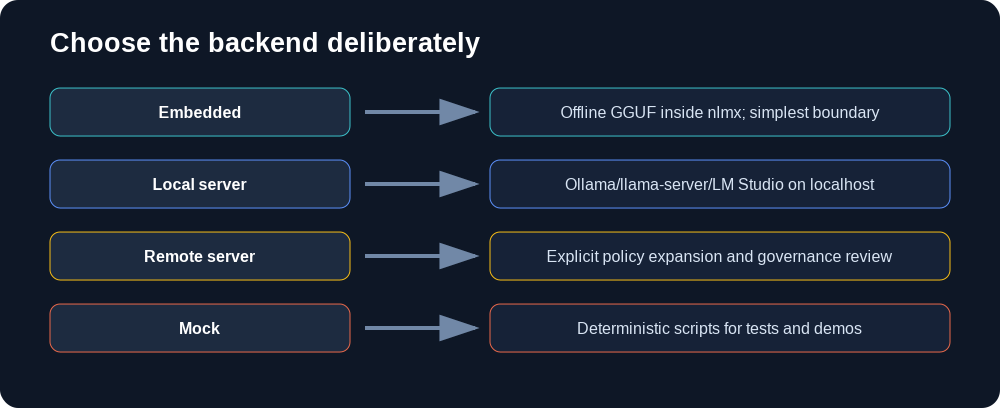
Choose from a written requirement: supported backend, available RAM/VRAM, acceptable latency, context length, JSON/grammar behavior, licensing, offline requirement, and validation burden. A 4-bit 3B GGUF is roughly 2 GB and commonly needs about 2.5–3 GB while running; actual use depends on runtime and context.
Practical interpretation
Qualify the exact model file or server name with a fixed request suite: valid one-step and multi-step plans, deliberate unknown options, forbidden paths, settings generation, failure correction, warning preservation, and result-sign interpretation. Record model hash/name, quantisation, backend, nlmx version, settings, hardware, seeds, and pass criteria.
A practical qualification sequence
Begin with guide mode and a frozen set of ordinary-language requests. Include an easy request, a request needing a settings file, a request with an intentionally nonexistent option, a forbidden path, a multi-step request, and a result containing warnings or an unfavorable comparison. Score whether the model chooses the correct nlmx command, asks when information is missing, preserves the requested endpoint and population, uses only real settings keys, and reports the native result without changing its direction. Repeat the suite because a single successful response is not a stability test.
“Instruction-tuned” means the model has been trained to follow requests; it does not mean the model understands pharmacometrics or has been validated. Quantisation reduces model size and can alter behavior. Treat a different GGUF quantisation, server tag, prompt, context size, or runtime as a change requiring at least regression testing. Record both successes and failures, with predefined acceptance criteria, before the model is allowed to propose executable work.
A safe novice workflow
- Start with the narrowest backend, policy, files and command set that can answer the request.
- Name exact inputs and decisions; use guide or plan-only before granting execution.
- Inspect the normalized command and complete settings file, not only Maxson’s explanation.
- Read request end state, native command result, warnings, outputs and checksums.
- Preserve the session and record the qualified person’s interpretation and disposition.
Review and pitfalls
Use the model to translate and summarize, not to make final model-selection, causal, dose, or regulatory decisions. A smaller model may work for simple requests but omit caveats or lose state in long chains.
- A session exit code of zero does not prove that every proposal ran or succeeded.
- Model fluency, structured JSON, and policy approval do not establish scientific validity.
- Settings and commands are reproducibility inputs; they still require versioned software and frozen data.
What to retain
Retain .ask, backend/model identity, system prompt, request, raw/normalized replies, transcript, JSONL events, settings versions, commands, child logs/outputs, checksums, exceptions, and reviewer conclusions.
Navigation
See the previous page, next page, and complete ask command and settings index.