19.19 The SAEM trace objective is not a likelihood
The trace stored during SAEM is
sum_i mean_c[Jy_i(eta_ic) + eta_ic′ OMEGA^-1 eta_ic]
    + N log|OMEGA|.
It is a sampled complete-data stability measure. It changes with conditional draws and does not integrate ETAs. It is not the marginal OFV and must not be used for AIC, BIC, LRT or comparison with FOCE/Laplace OFV.
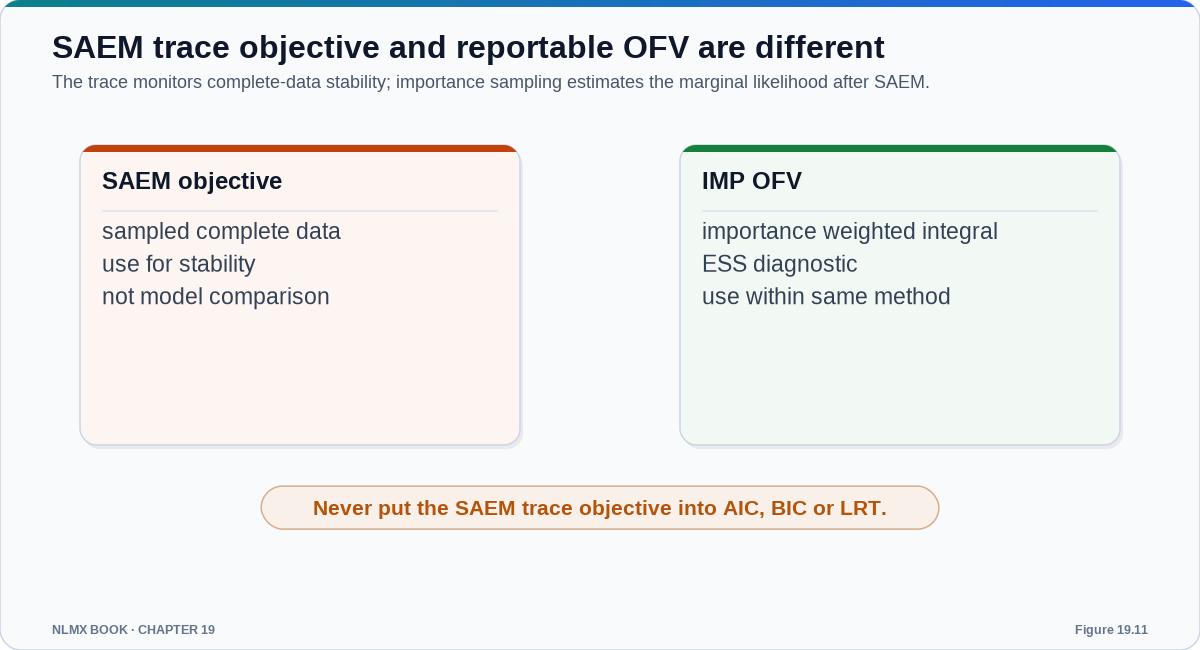
The trace is still useful: persistent trend suggests burn-in instability; noisy level changes can reveal mixing or parameter movement. In .ext, burn-in iterations are labelled negative through zero, and accumulation is positive 1…NITER.
The reportable OFV follows from importance sampling after SAEM. A model can have a stable trace yet poor importance ESS, and vice versa.
Practical interpretation
Label plots “SAEM stability objective” and never simply “OFV.” In automated pipelines, store it in a separate field from objective_function_value used for information criteria. Add a validation assertion that AIC/BIC inputs come from IMP after SAEM.
Trace comparisons across different chain counts can change noise and sampled complete-data values even at identical population parameters. Use them to assess within-run trend, not rank models. For model comparison, compute adequate-ESS IMP objectives under aligned settings and Monte Carlo tolerances.
Documentation and software labels should make this distinction impossible to miss. Add automated schema tests preventing a trace row from populating the final OFV field.
Common mistakes
Do not copy the last SAEM objective into a publication table, compare its value across chain settings as likelihood, or expect monotonic decrease.
Checklist
- Label trace objective explicitly.
- Use it only for stability diagnostics.
- Verify phase iteration labels.
- Obtain final IMP OFV and ESS.
- Keep method consistent across comparisons.
Further reading
Continue to importance sampling and revisit Chapter 18 marginal likelihood.