Backward elimination step by step
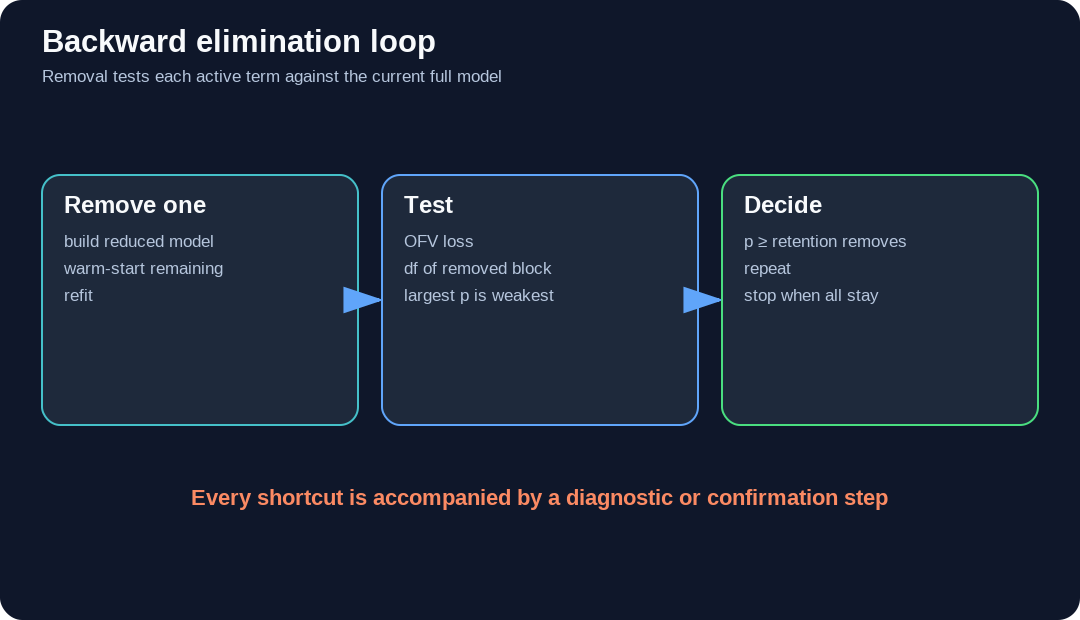
Backward elimination begins with an active model and fits one reduced model per removable relationship. The OFV loss from deleting each block is tested against the current full model. The term with the largest p-value is the weakest conditional contributor. It is removed when p >= retention_alpha; otherwise all active relationships satisfy the retention rule and the stage stops.
After a removal, all remaining terms are retested because their conditional evidence may change. Forced relationships are not eligible for removal. Degrees of freedom follow the deleted coefficient block, so comparisons between one-df and multi-df relationships must use p-values, not raw ΔOFV ranks alone.
In the verified backward-only run, the five-effect full model had OFV −1158.649. CL–SEX was removed first (p=0.7203), V–SEX second (p=0.4003), and the remaining WT/EGFR terms all had p below 0.01. The final endpoint matched the forward and both-direction runs.
Common mistakes
- Treating a stepwise p-value as clinical importance or causal proof.
- Reading a candidate comparison without its active model, convergence state, degrees of freedom, and exact threshold.
- Reporting only the terminal relationship list while discarding failed models, path decisions, configuration, and provenance.
Page checklist
- The scientific question, model identities, and comparison direction are explicit.
- Numerical validity is reviewed before interpreting statistical evidence.
- The result is linked to the complete trace and final joint-model diagnostics.